
Understand your emotions.
Master crises. Live your life.
Marcus'Mood supports you — in understanding what's going on inside, finding skills that could help in difficult moments, and recognising your own patterns over time. No account, no subscription.


The App in Action
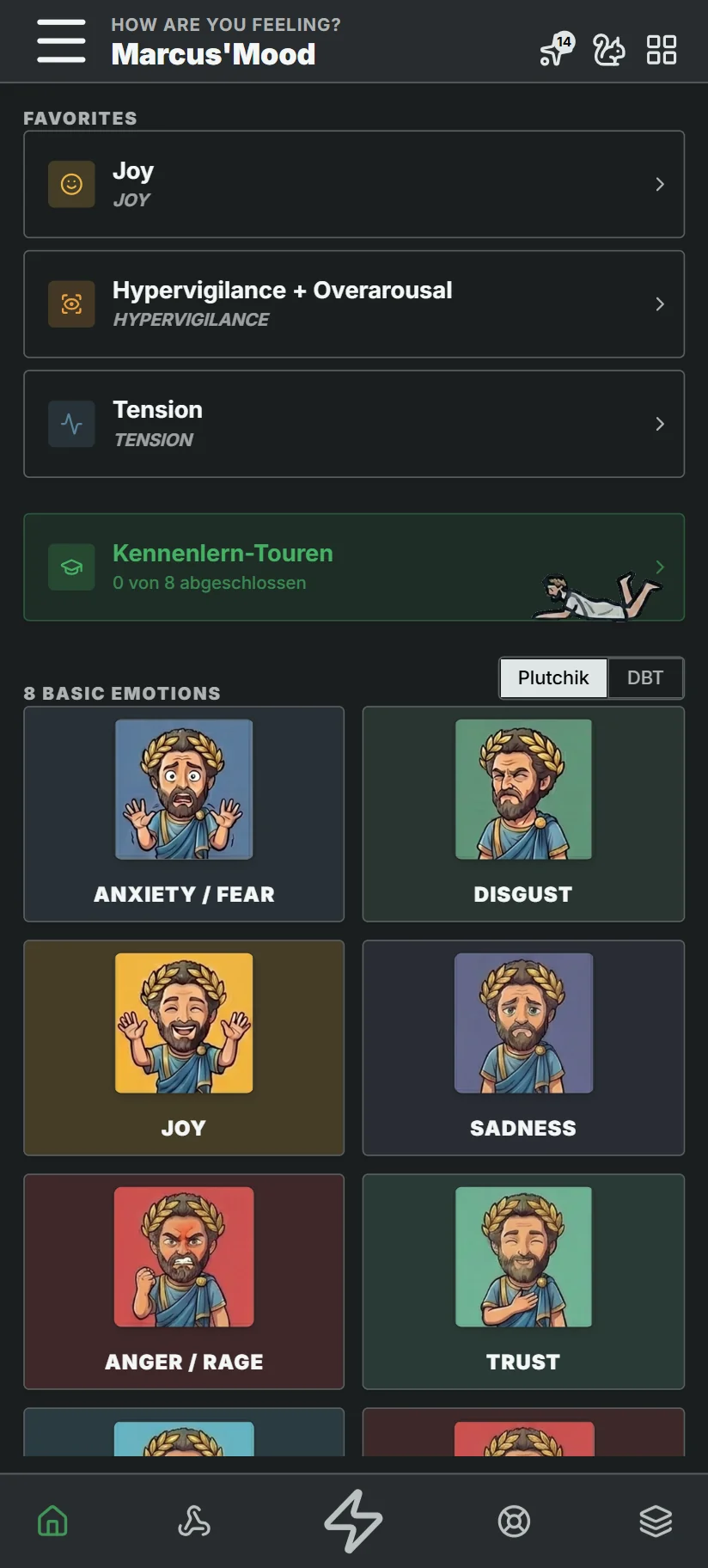
Starting point
111 emotions – one fits exactly
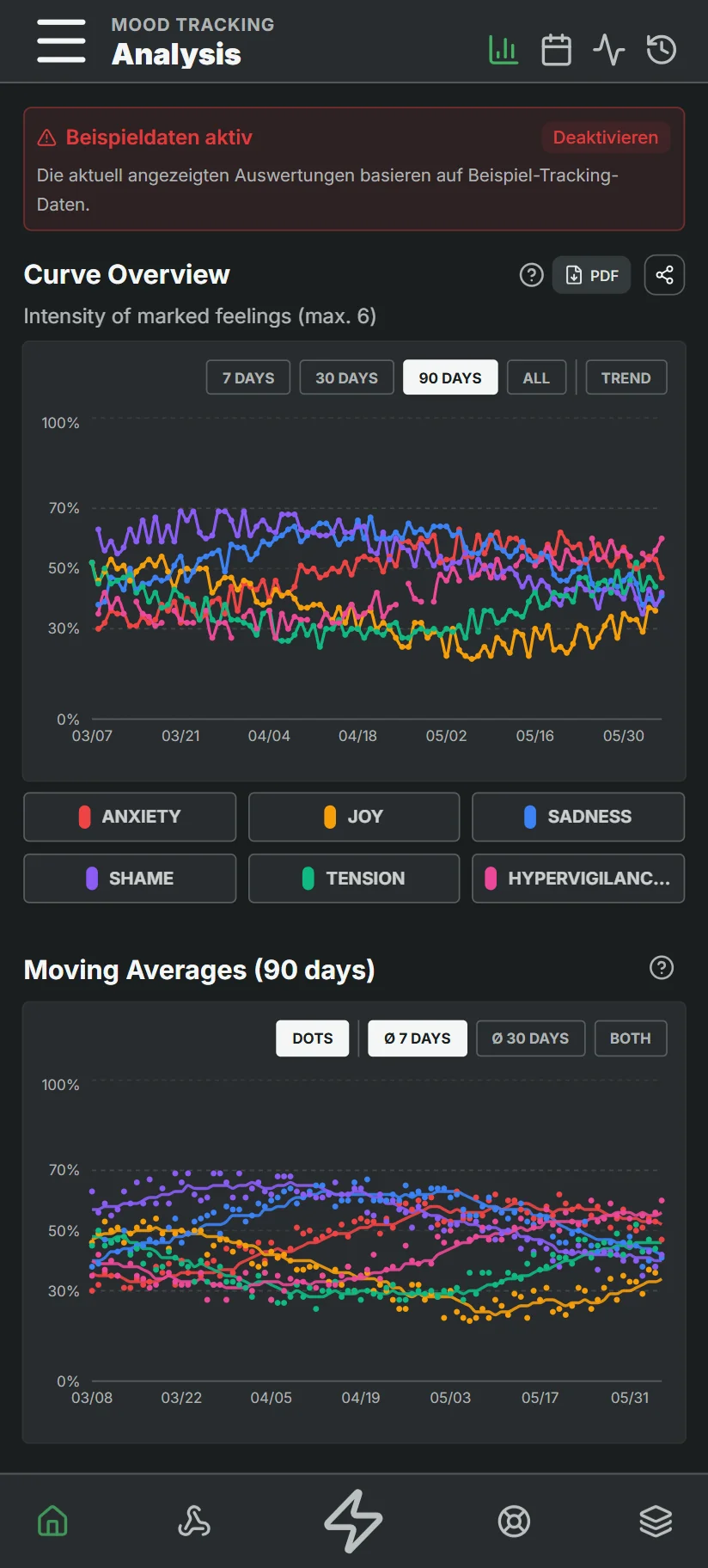
Your history
Spot patterns over weeks
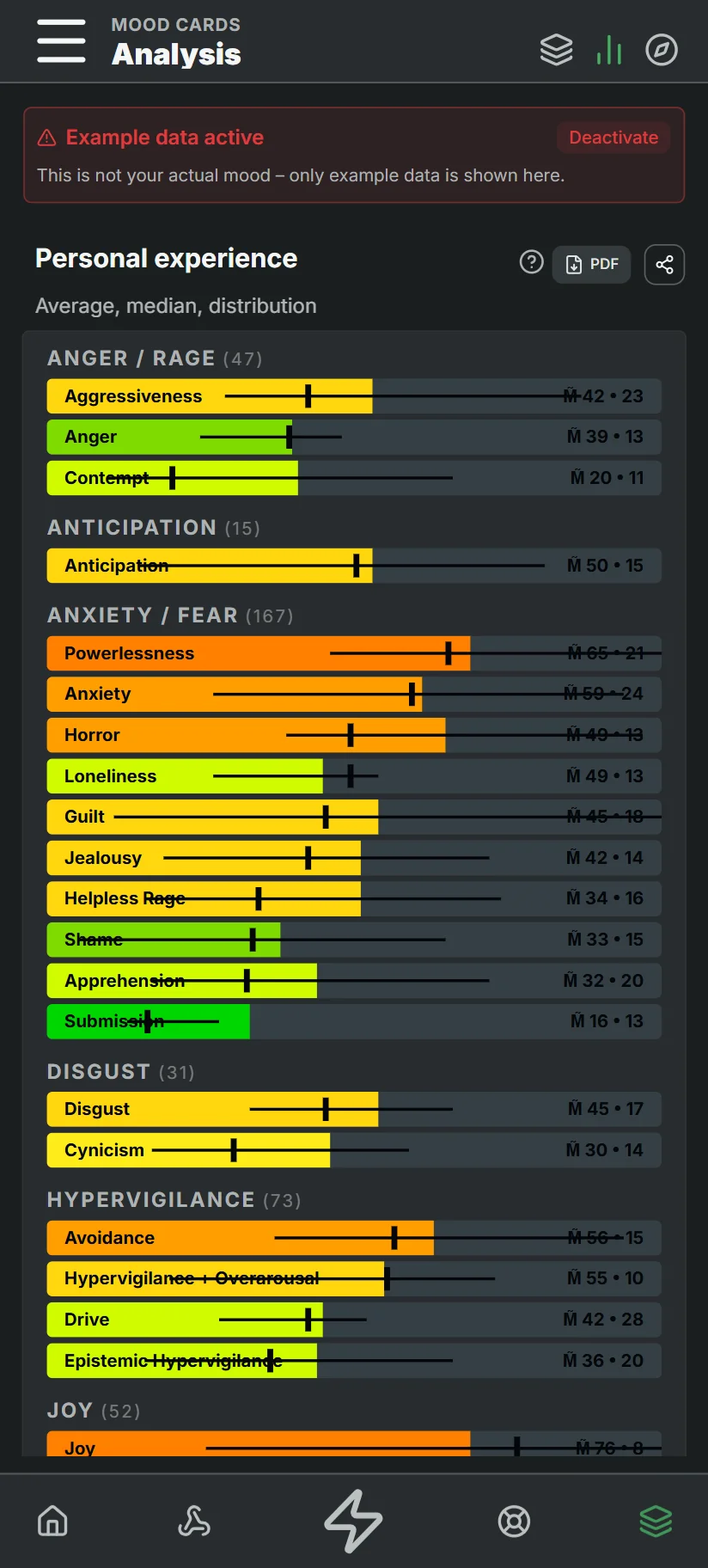
MoodCards
Discover blind spots
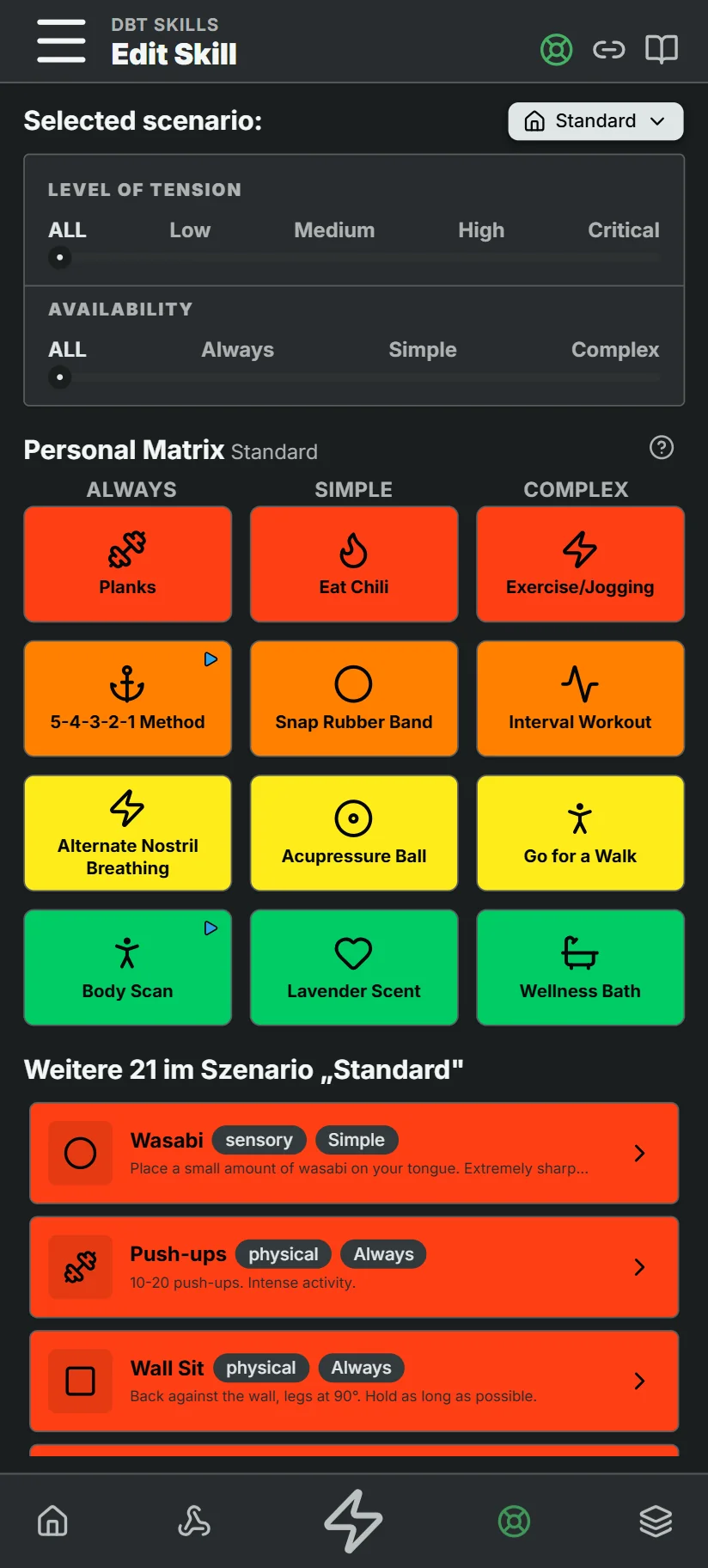
Your emergency plan
Skills – always at hand
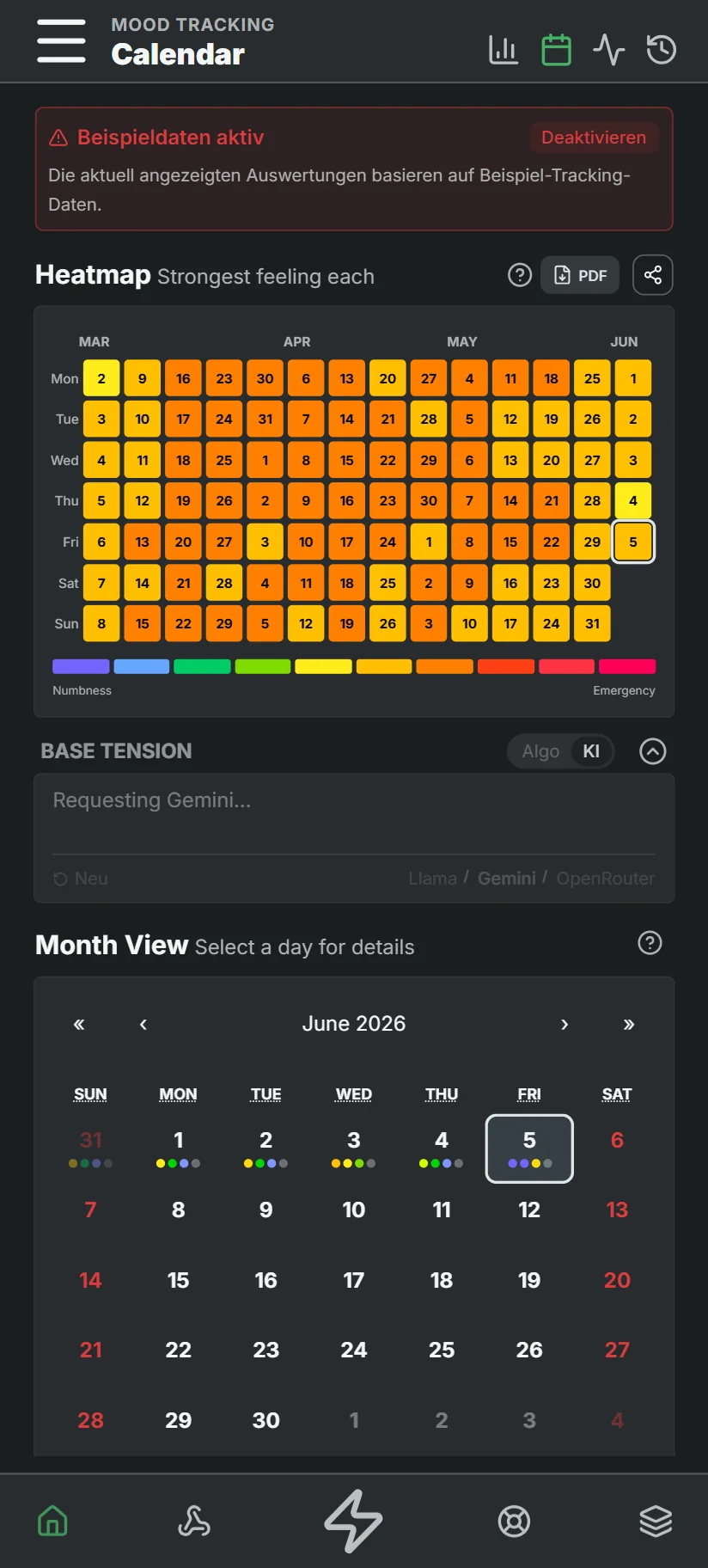
Calendar
Every day at a glance
For me?
What do you need right now?
Everyone comes from a different situation. Open what fits you right now.
Crisis & acute moment
It's too much right now.
In moments like this, a long text or onboarding doesn't help. No login. No loading. You open the app — and you're immediately at the skill that could help right now. One tap.
You know what Opposite Action means. You know Wise Mind, TIPP, breathing exercises. But between sessions you're often alone with it — and in the moment of tension you can't find the right skill. Marcus'Mood finds it for you.
Understand & make sense of it
I know the feeling – but not its name.
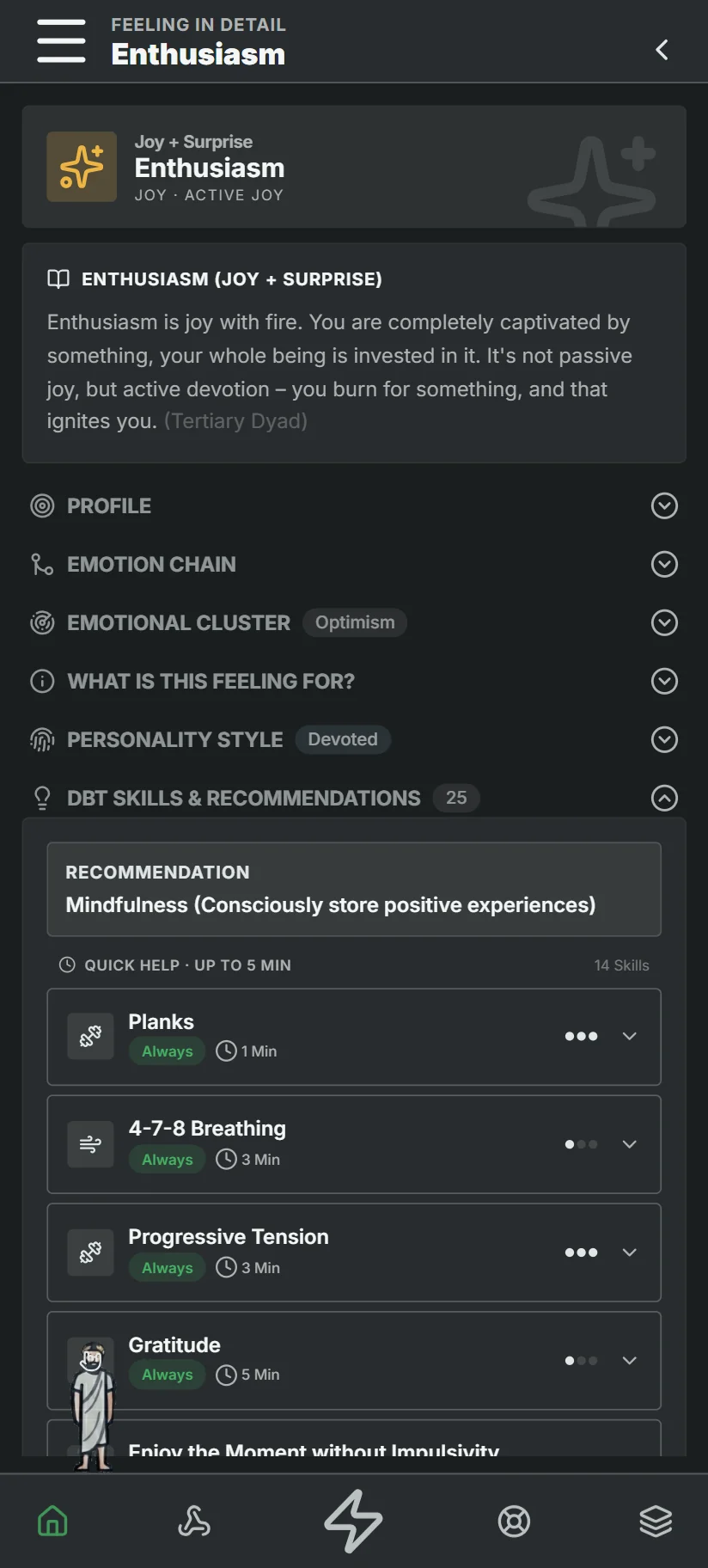
You don't need a diagnosis to understand your emotions better. 111 emotions – many of which you've never named. Each has a profile: where does it come from, what triggers it?
You already track a lot – but what really moves you? Emotional patterns only emerge when you name them. The data accumulates along the way, the patterns appear by themselves.
Plutchik, dyads, emotion chains – you know the theory from therapy. Here you encounter it through your own emotions, not in a textbook.
Long-term history
What changes only becomes clear when you look back.
What is changing through therapy? The history makes visible what you often only hope for – curve, PLEASE correlation, PDF for your next session.
Patterns only show up over weeks. When are you regularly tense? What really influences your baseline mood? The answer is in your own data.
Your clients come with weeks of history, PLEASE factors and concrete data – no vague memories, but a real foundation for the session.
DBT therapy companion
I'm in DBT therapy and want to actively engage
Tension is rising. You know what could help right now — but you can't find it. Marcus'Mood knows your tension level and shows you the skills that could fit this moment. No searching. No thinking. Just one tap.
Between sessions you're on your own with your therapy. Filling in the diary card, practising skills, keeping PLEASE in view — Marcus'Mood turns this into a habit that doesn't feel like homework.
You don't want to arrive at sessions with vague memories anymore. The history of the past week, PLEASE factors, MoodCards — all as a PDF. Your therapist sees what you experienced, not just what you can still remember.
Patient
You track your emotions with terms you know from therapy. Your skill kit grows with every session – filled with what actually helps you.
Therapist
Receives the data as a structured PDF report – mood history, PLEASE factors, MoodCards assessment. The same language, ready for the next session.
One tool that connects rather than separates.
For therapists & professionals
I want to give my clients something reliable.
Your patients bring to the session what they experienced between appointments – structured, not as a vague memory. The PDF report speaks for itself.
You support people through difficult phases and need a tool that thinks with you. Marcus'Mood gives your clients structure between appointments – and gives you a shared language.
Daily routine
Pause briefly each day – and see what emerges.
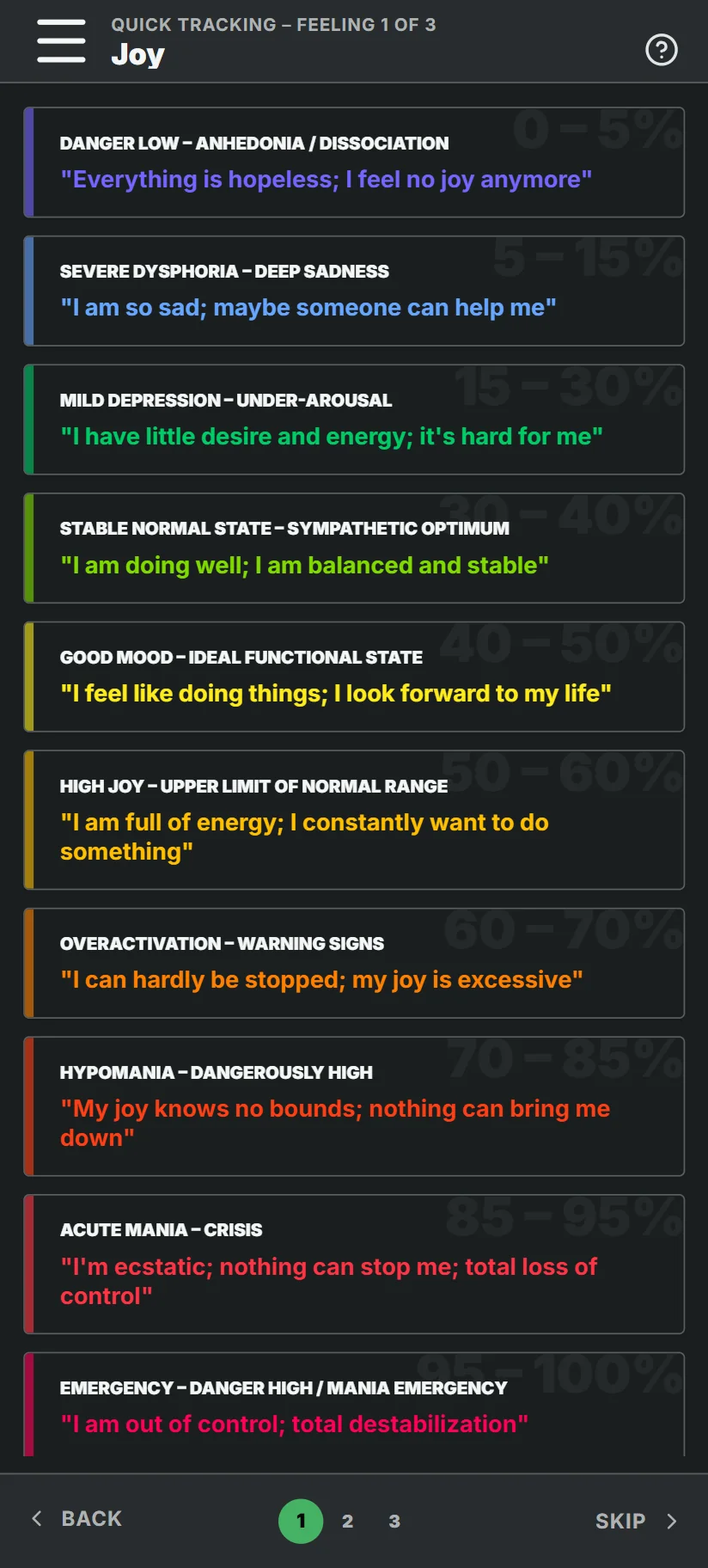
With Fast Track: tap favourite emotions, choose intensity – done. Under 30 seconds a day, no required fields. Over weeks a picture of yourself will emerge that will surprise you.
Filling in the diary card daily is a therapy task. With Fast Track – set favourite emotions once, then just tap intensity – it's done in under 30 seconds. At the end of the week, directly as a PDF for your therapist.
In practice
From emotion to the right skill –
in under 30 seconds.
No essays. No thinking. Just start — the app guides you.
Primary flow
Step by step – or straight to the point.
With saved favourites, two taps are enough. Steps 2, 4 and 5 are always optional.
Open emotion
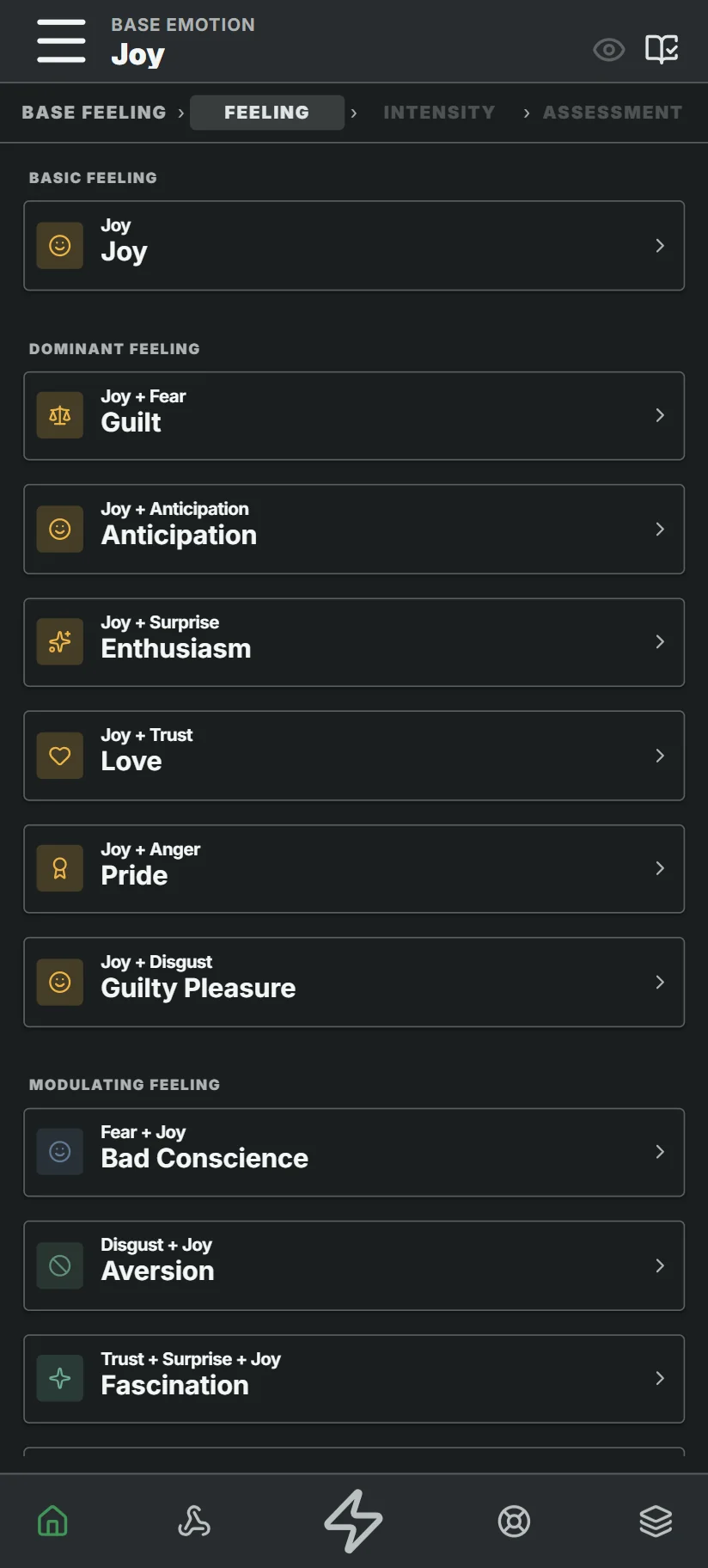
Select emotion
⚡ Skipped with favourites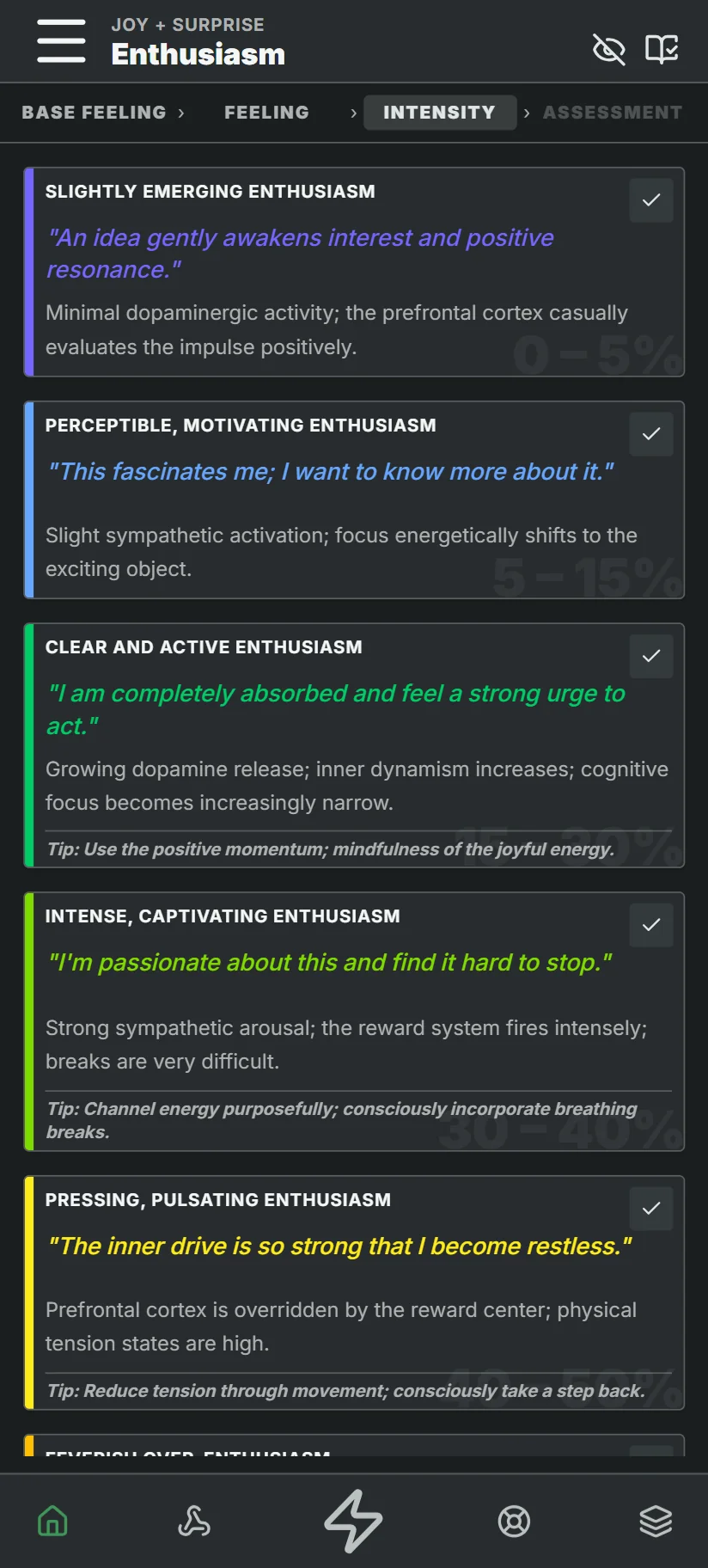
Rate intensity
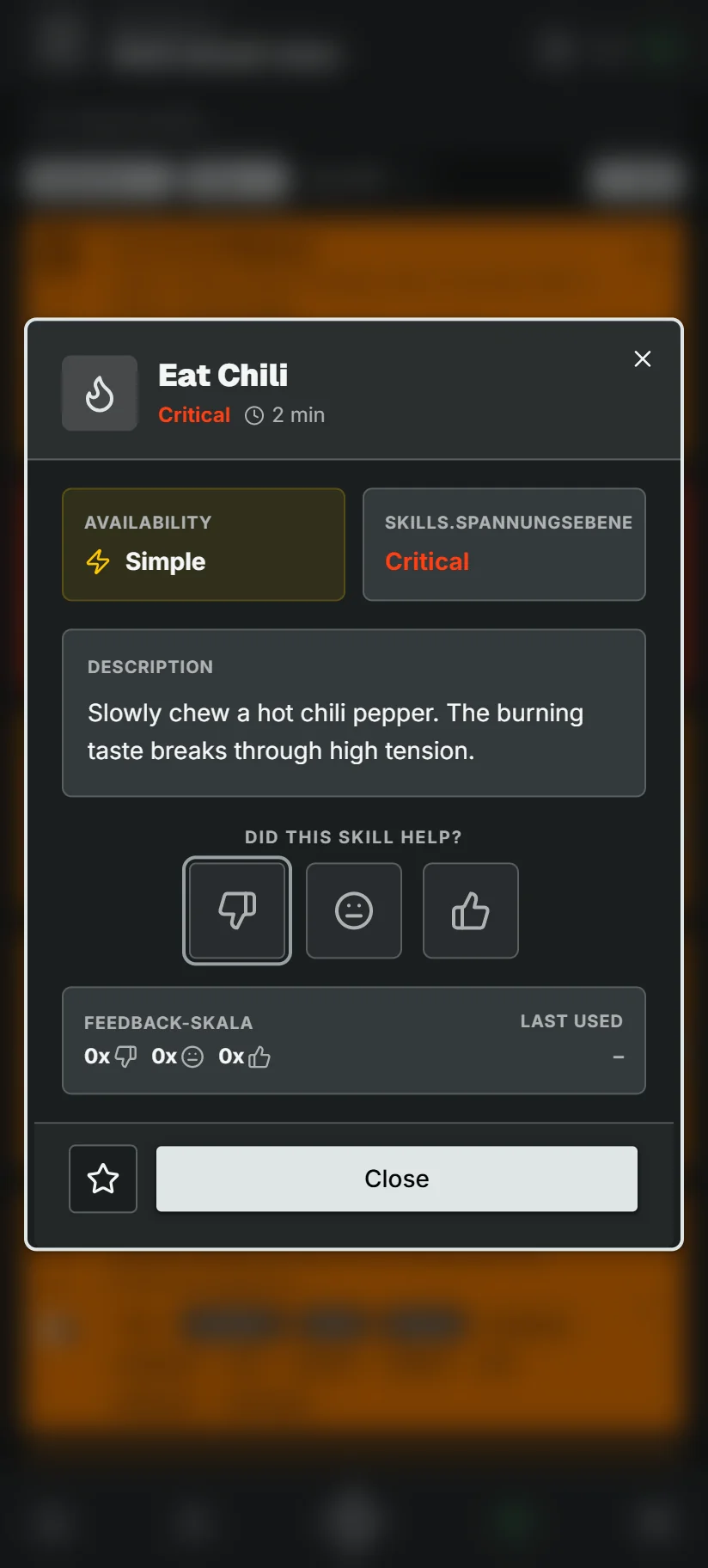
Your skills
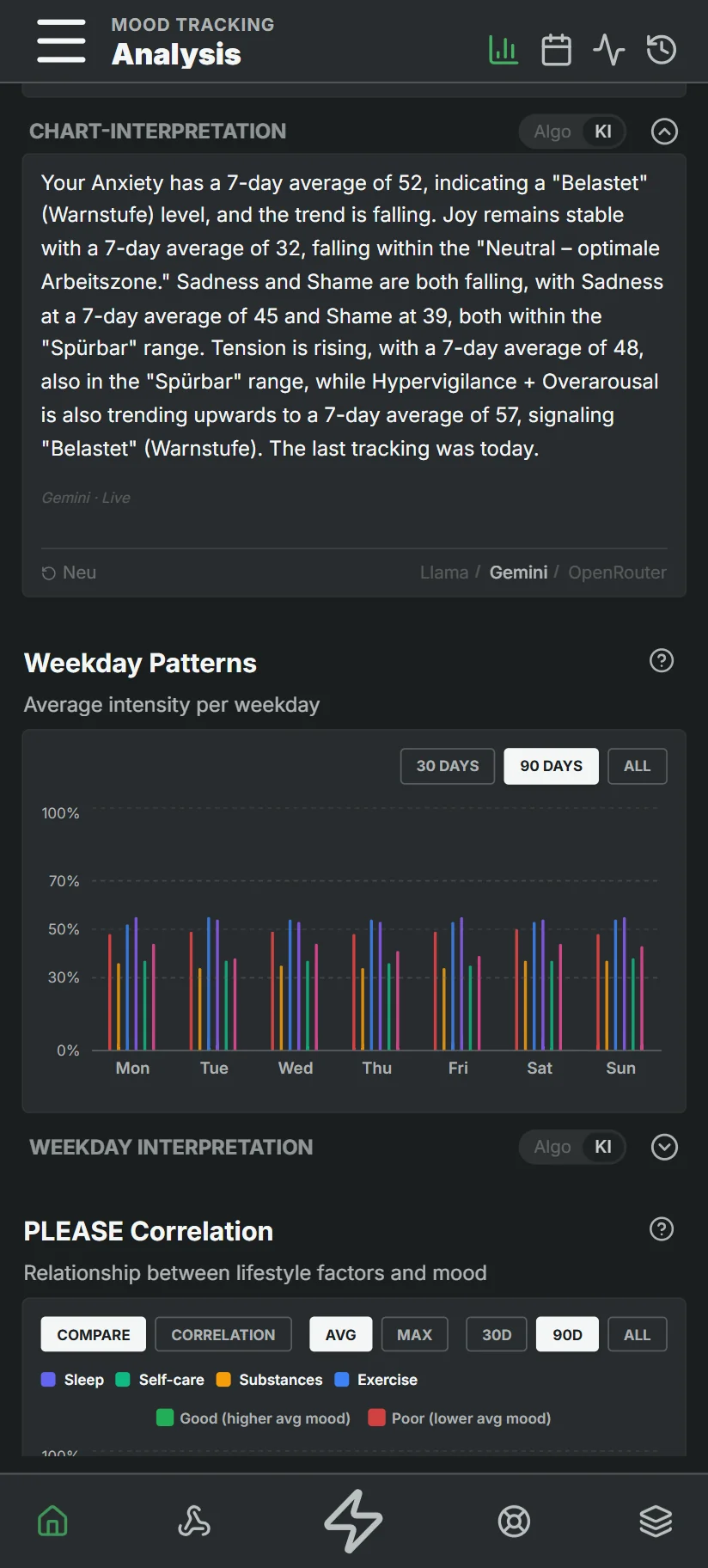
View history
Fast Track
Tracking in seconds – not minutes.
When you first open the app, five common emotions are already saved as favourites. No setup, no searching – you can start immediately. And you can customise the selection at any time.
Tap the zap icon
The ⚡ in the footer opens Fast Track directly – from anywhere.
Choose intensity
For each favourite emotion: how strong is it right now? Or skip.
Done
Brief summary, matching skills – and you can carry on.
5 taps. That's it.
With three favourites your daily check-in takes under half a minute – even when things aren't going well.
Built for difficult moments.
Fast Track is not optimised for good days. It works precisely when energy and focus are in short supply.
Routine, not effort.
The shorter the entry takes, the more likely it actually happens – every day, not just when you feel like it.
Level 2
More than tracking — everything that matters long-term.
Skills, patterns, analytics, AI insights. Strong individually, a system together.
Skills & skill kit
No searching when things get hard – your kit is already packed.
Decide now, calmly, what helps – so you don't have to decide anything in a crisis.
The skill system at a glance
This is the DBT principle behind the skill system: you build your emergency plan in a calm moment. When it counts, you only need one tap.
- Skill library – 167 immediately available skills – plus 695 additional DBT+ skills (Pro) available as an add-on
- Skill matrix – 4 tension levels × 3 availability tiers – at a glance which skill fits when
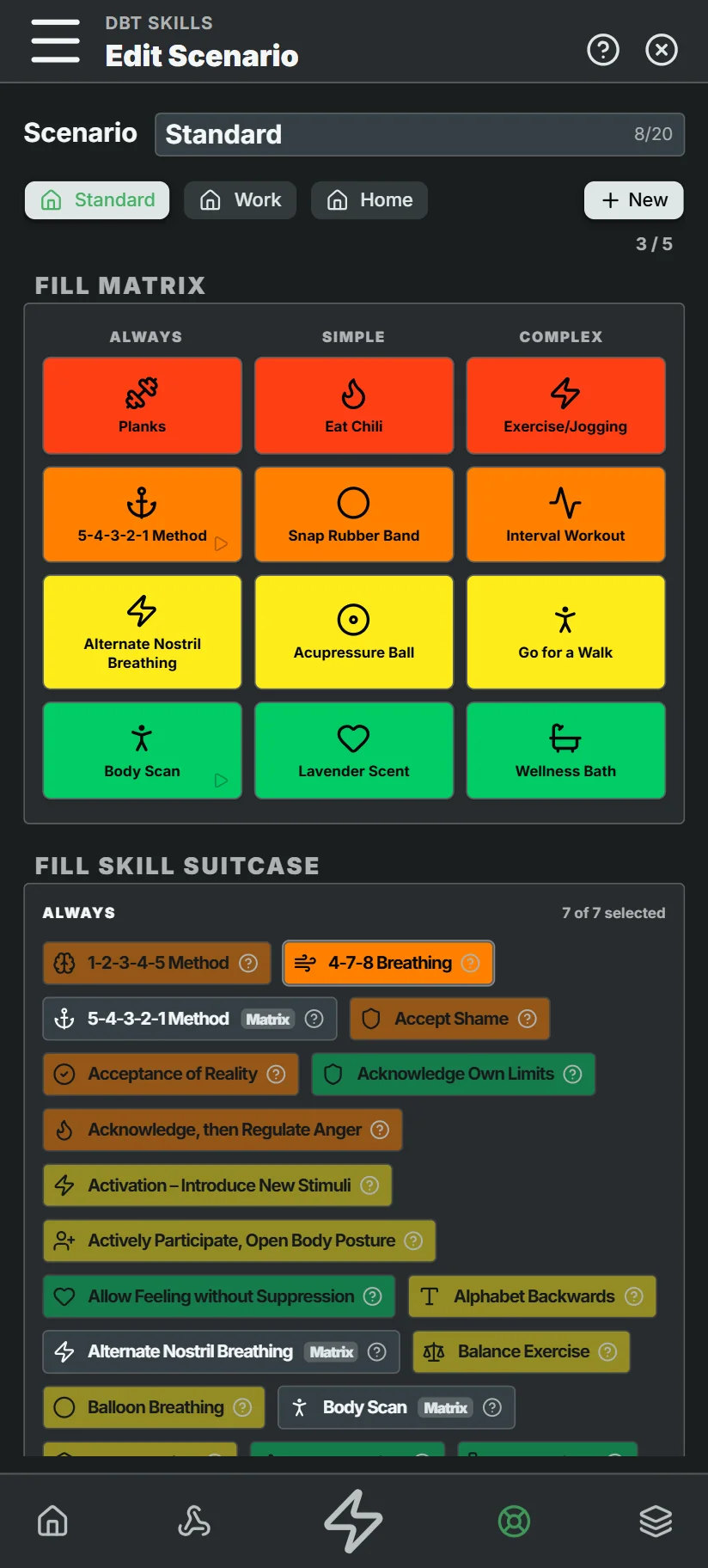
- Scenarios – up to 3 personal contexts (e.g. "At home", "Out") – each with its own matrix
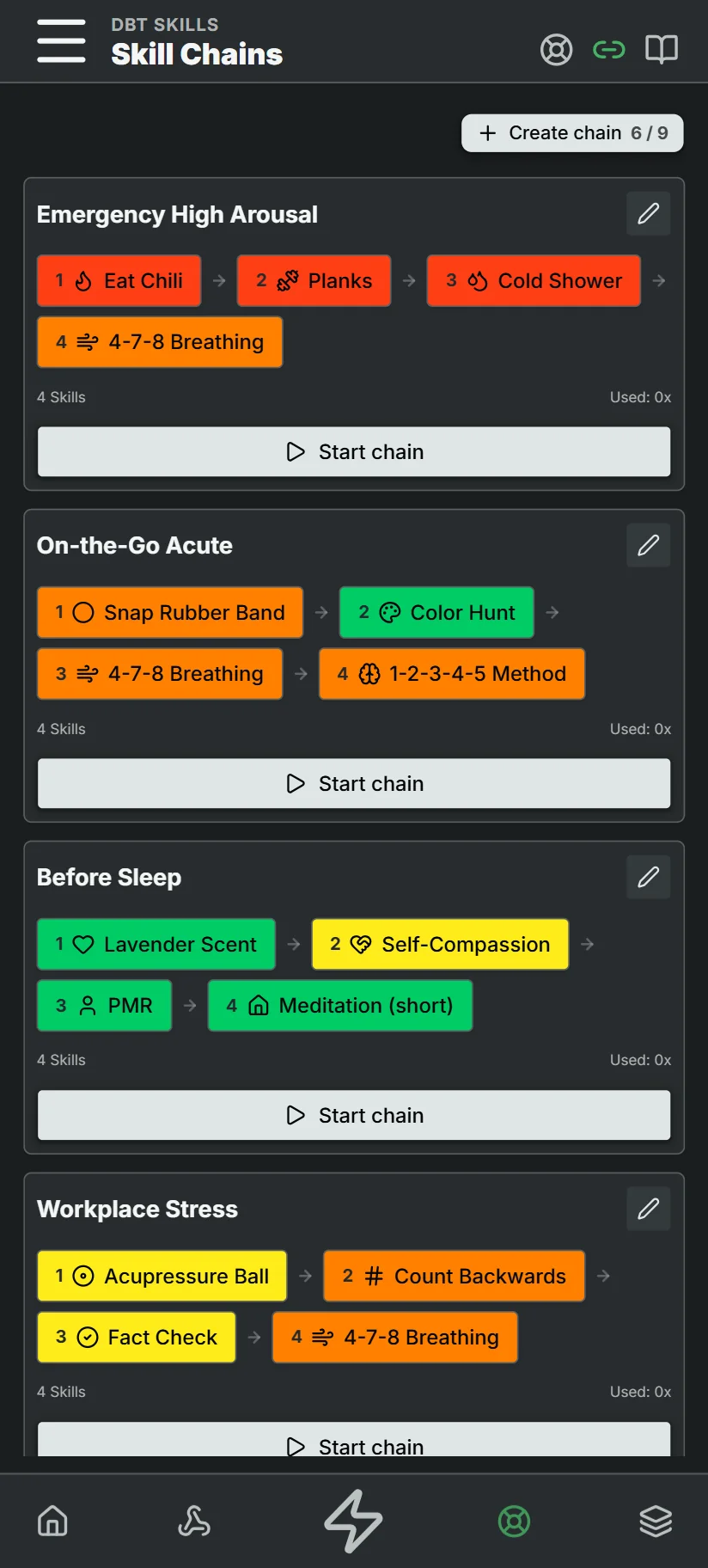
- Skill chains – sequences for situations where one skill alone isn't enough
- Custom skills – create your own by text or audio – or permanently hide existing ones
- Hide – permanently deactivate skills that trigger you or you never use
Skill library
You open the library – and immediately see what's available. No setup, no searching. 167 skills from all DBT modules, ready to use.
- 167 standard skills immediately available – no setup needed
- DBT+ (Pro): 695 additional skills – available as an add-on
- Skill matrix: 4 tension levels × 3 availability tiers
- Usage counter shows which skills you actually use
Skill matrix
In the moment of crisis you already know what works – because you decided in advance. The matrix is your personal emergency plan: 4 tension levels, 3 availability tiers, filled by you.
- Tension levels: low / medium / high / extreme
- Availability: always / easy / demanding
- In a crisis: filter to your current tension – only matching skills visible
- A separate matrix configurable per scenario
You prepared. That's the difference.
Scenarios
You're a different person at home than out and about. Scenarios take that seriously: each context gets its own plan – built in advance, instantly accessible in a crisis.
- Up to 3 scenarios (e.g. "At home", "Out", "Work")
- Each scenario has its own skill matrix with its own skill kit
- In a crisis: one tap on the scenario, filter by tension – no searching
- Switch quickly depending on context
No thinking when things are hard. You've already done that.
Skill chains
Sometimes one skill isn't enough – some situations need a sequence. Chains link multiple skills in the order that helps you: as a crisis protocol, a morning routine, an evening ritual.
- Combine any skills in any order
- Start a chain → guided step by step
- Usage counter: see what you actually use
- Great for morning routines, evening rituals, crisis protocols
Integrated tools
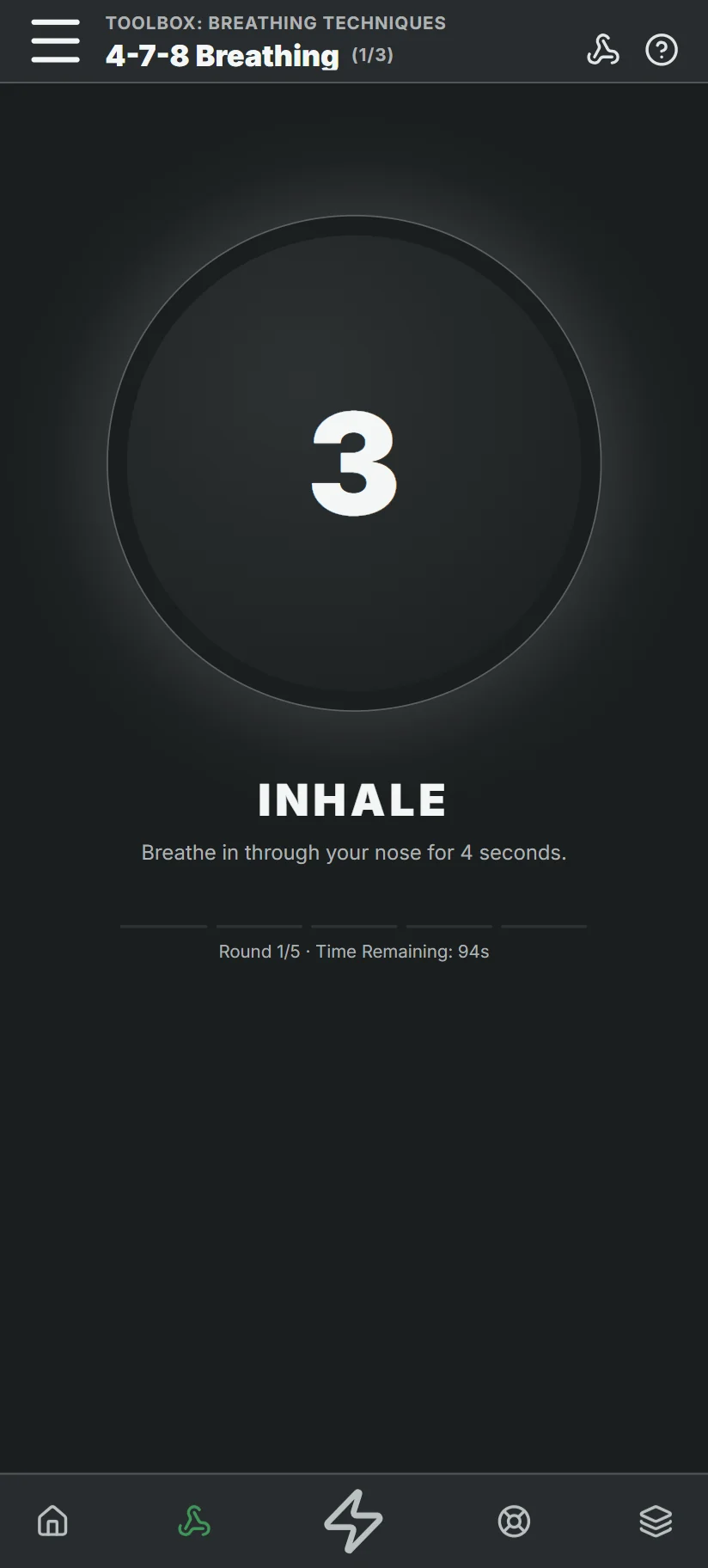
Some techniques need more than a text. These tools run directly in the app – with animation, timer or guided flow. No leaving the app, no external searching.
- Breathing exercise with visual animation and adjustable rhythm
- 5-4-3-2-1 grounding guide
- Body scan and progressive muscle relaxation (PMR)
- Tools are embedded directly in the skill library
Custom skills & personalise
A library that fits you gets used. One that doesn't, gathers dust. Create custom skills, hide triggering ones – until only what really helps remains.
- Create custom skills by text and add them to the matrix
- Audio skills: attach your own MP3 or external URL
- Permanently hide skills that trigger you or you never use
- Always reversible – no skill is ever deleted
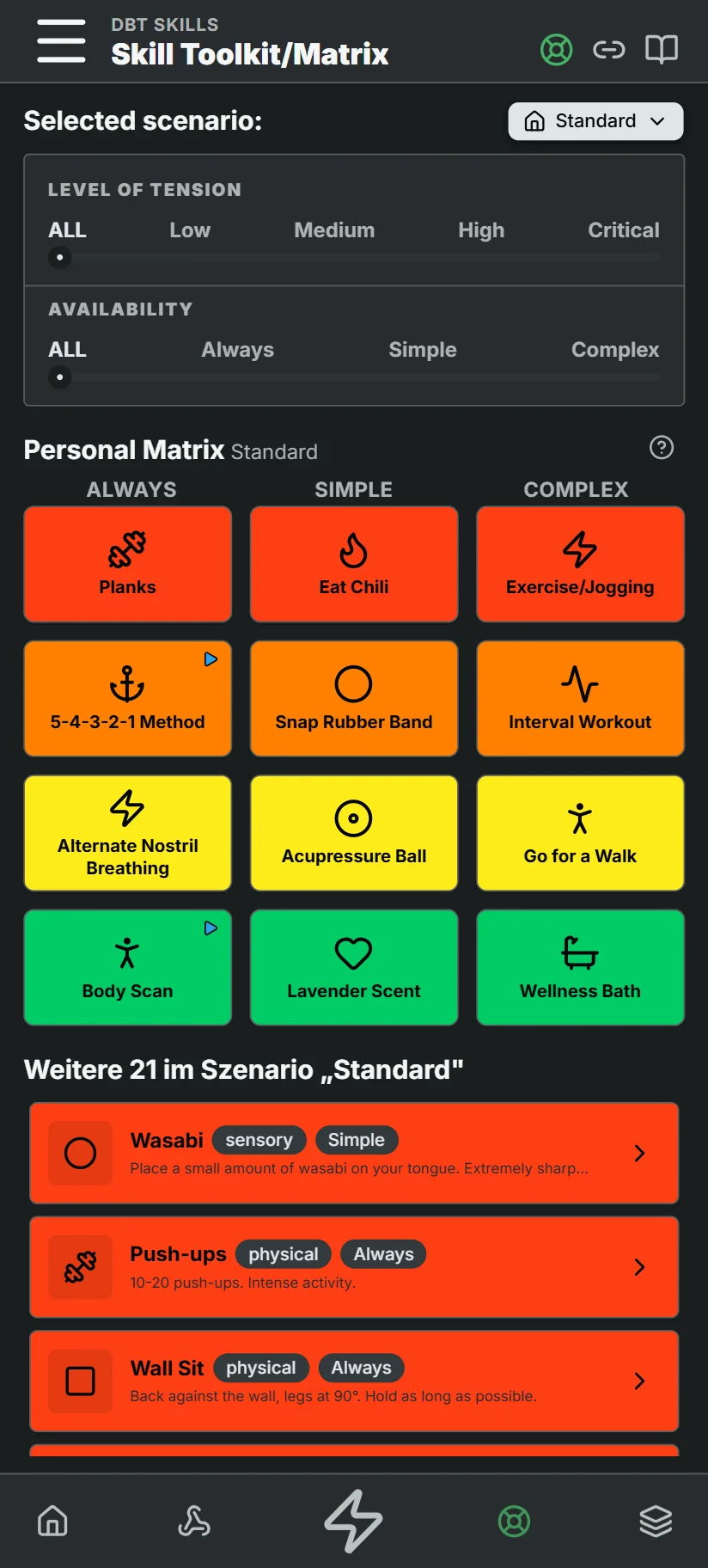
Skill matrix · skill kit
MoodCards
What moves you – before your mind starts to explain.
22 cards, no prior knowledge needed – you see your emotional profile without having known what you were being asked.
MoodCards at a glance
You know the feeling: you ask yourself how you are – and give the answer you expected anyway. MoodCards bypasses this. You rate a card before you know which emotion it shows. The result: an emotional profile without self-censorship.
- Assessment – rate the card before the name appears – projective method without self-censorship
- Reveal – the emotion is only disclosed after the rating
- Dashboard – weighted emotional profile from ~35 cards
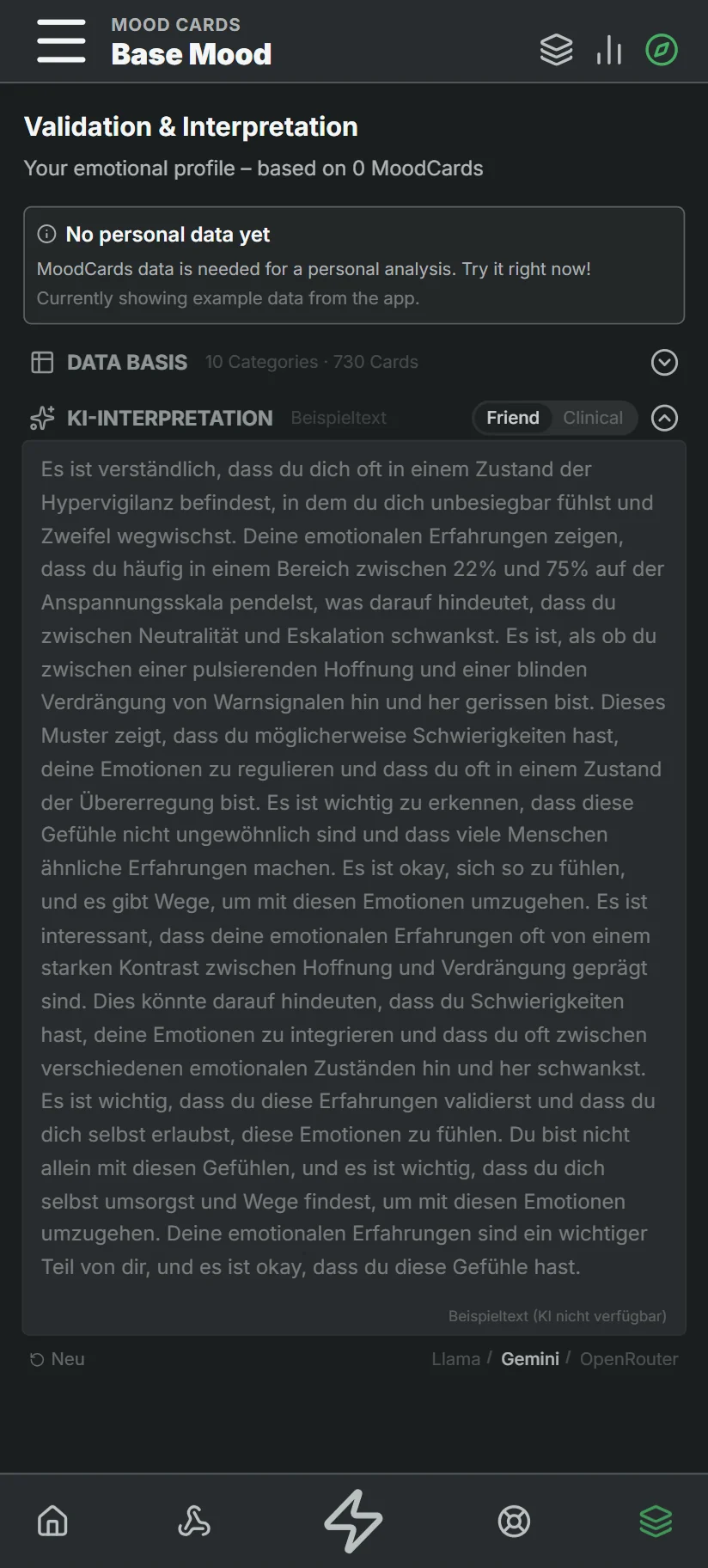
- AI interpretation – baseline mood analysis from 200 ratings
- History – how your profile changes over weeks
Assessment
The question "How are you?" has a catch: you already know your own answer before you ask it. MoodCards asks differently. One card, one description – you rate how frequent, how intense, how current. You only see the name afterwards.
- 3 dimensions: frequency, intensity, recency
- Random order – no systematic prior assumptions
- Short and focused: one card, three sliders
- Covers all 111 emotions from the Plutchik model
Reveal & feedback
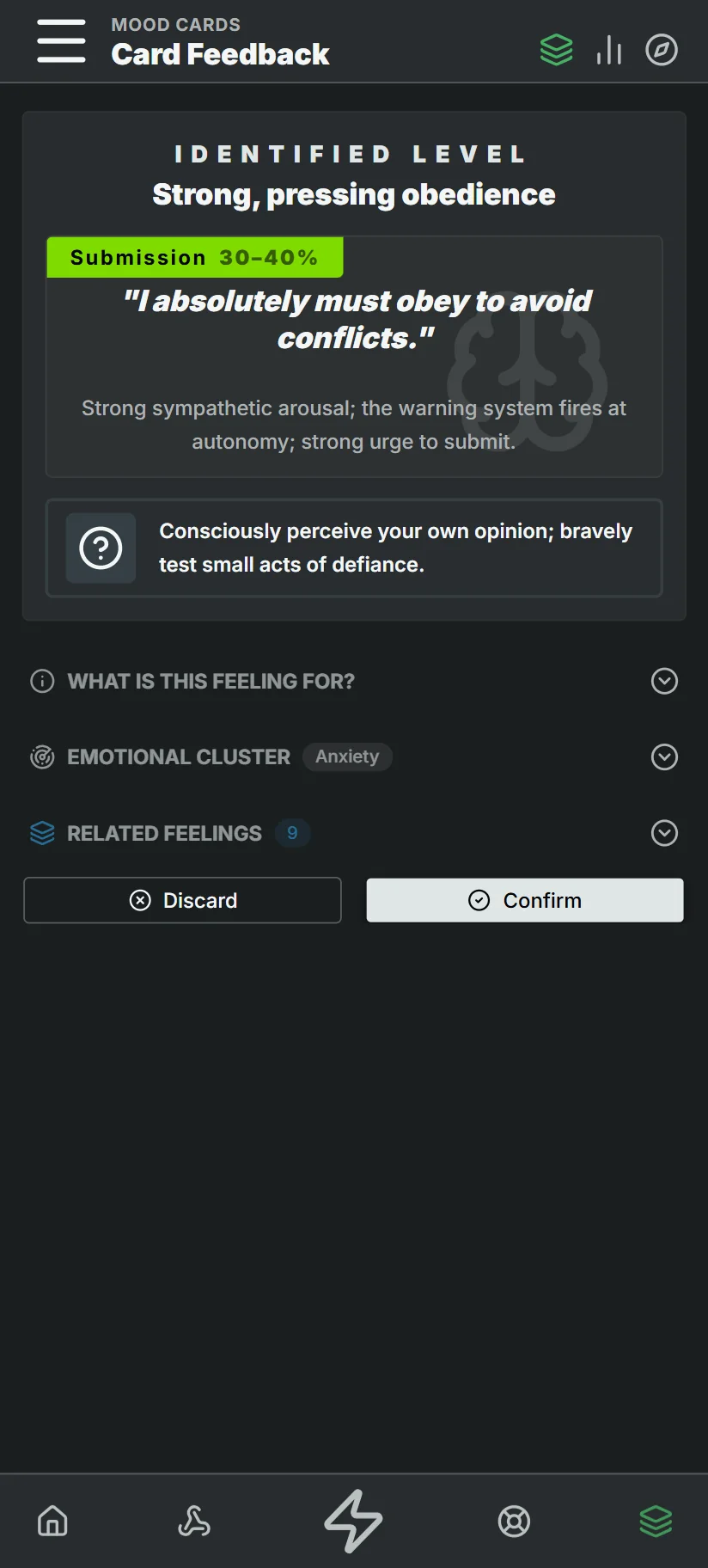
Sometimes the reveal confirms what you suspected. Sometimes it surprises you. Both are information – and only possible because you rated before you knew what you were rating.
- Name and description of the emotion are revealed
- Your values in context of your previous ratings
- Direct access to the emotion profile
- Immediate feedback: is your intuition close or far off?
* The card shows a description – not the name. You rate what you feel before you know what it's called. No prettifying, no averaged picture of yourself.
Dashboard & analytics
After ~35 cards a pattern emerges that you haven't talked yourself into. The dashboard shows which emotions systematically dominate your life – weighted by frequency, intensity and recency.
- Weighted profile: frequency × intensity × recency
- Horizontal bars with median and spread range
- Which primary emotions dominate – which barely appear
- PDF export for the therapy session – generated locally
AI interpretation
From 200 ratings the AI interprets your profile. No generic text – an interpretation of your own data. What shows up systematically? What surprises you? Conversation basis for your next therapy session.
- Which emotions are systematically dominant
- Patterns over time – what repeats
- Tone selectable: casual or clinical
- Your own API key – data goes directly to your provider
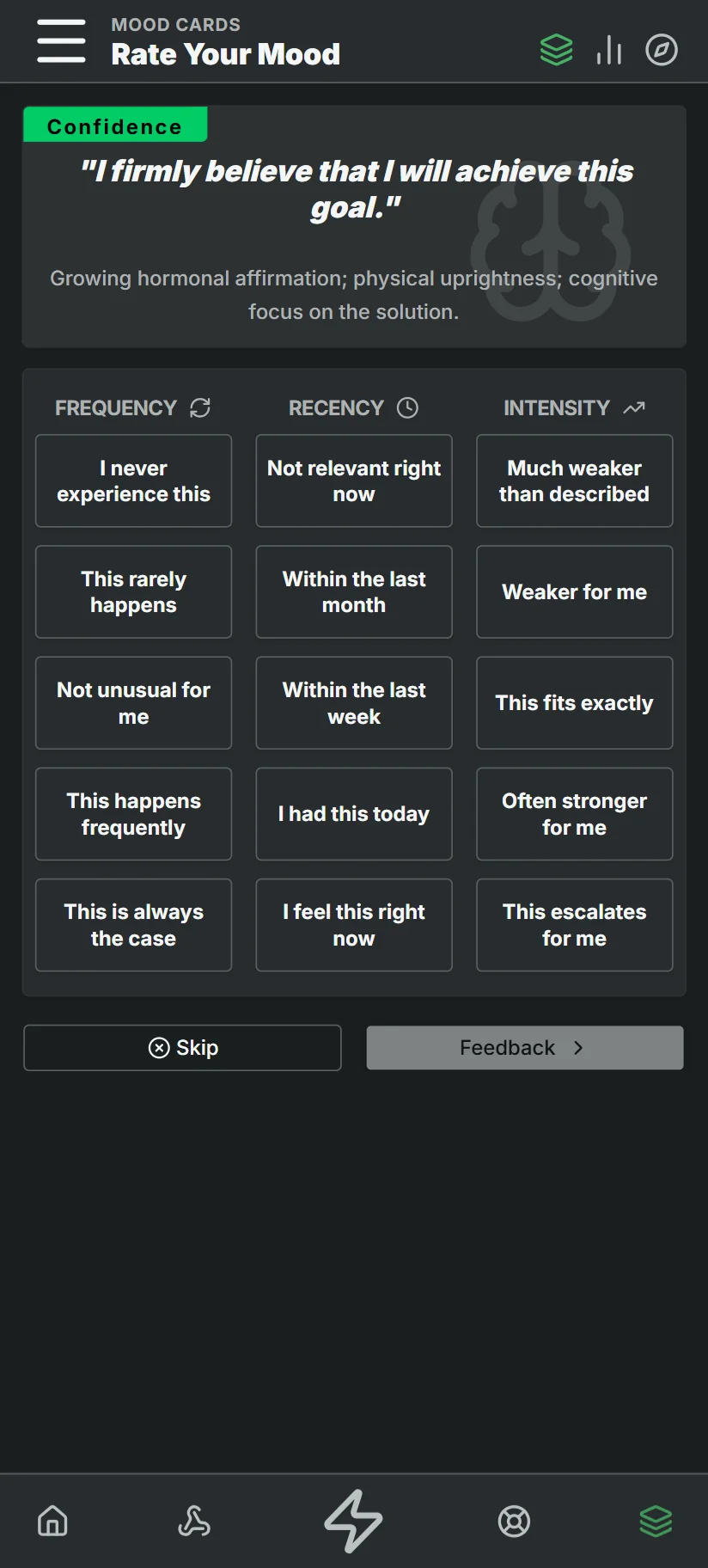
MoodCards
Emotion knowledge
Why you react the way you do – and what it does to you.
You don't need to memorise it – the app applies it when it counts.
Emotion playbook
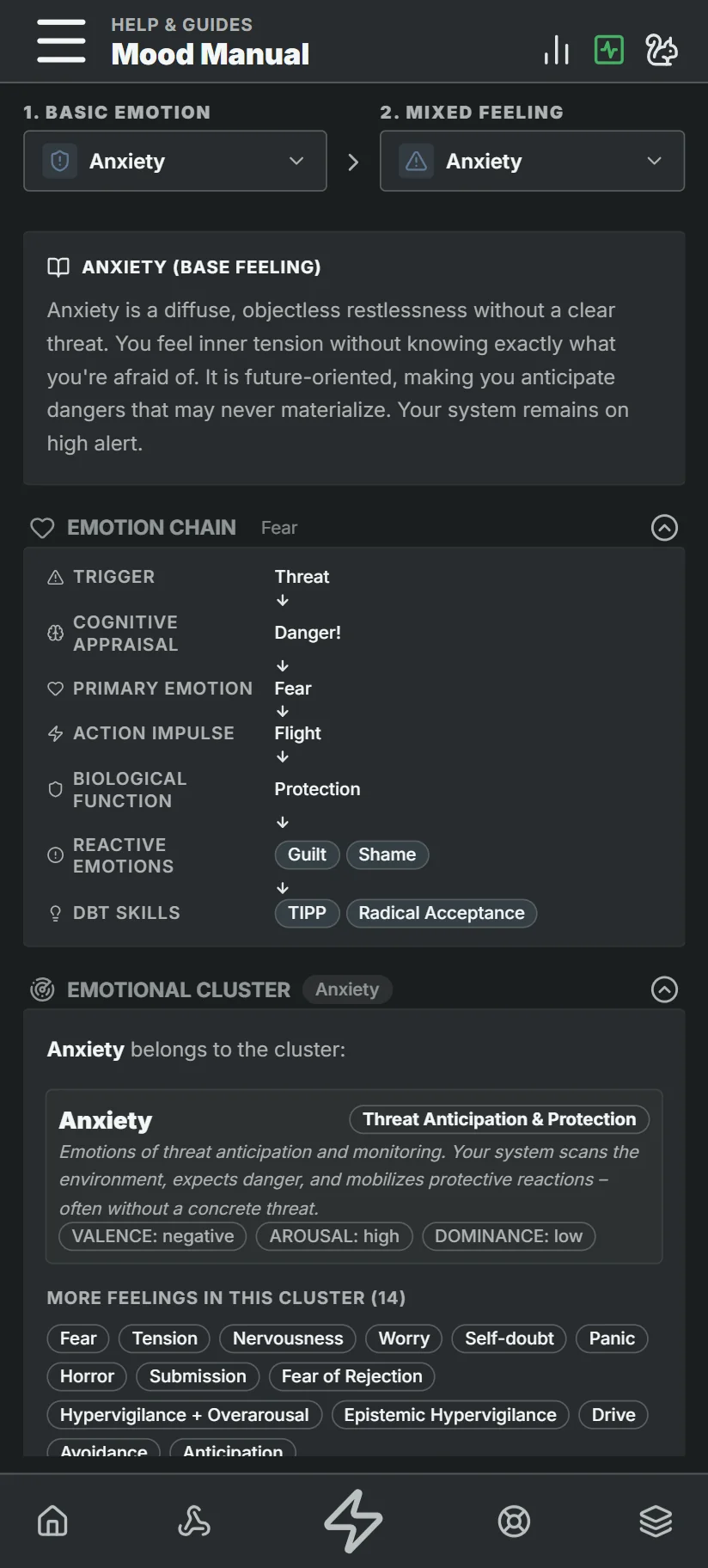
You react to something – and afterwards don't quite know why. Each of the 111 emotions has its own profile: where it comes from, how it escalates, what it does to you. Not as a reference – as a mirror.
- Where the emotion comes from – triggers, body signals, biological function
- Escalation chain: what happens if you don't intervene
- Related emotions visible – so you recognise the right one
- Direct skill recommendations for exactly this emotion
Scale playbook
Between numbness and emergency lie ten levels. Knowing where you are right now – not just "bad" or "very bad" – is the difference between preventing and escalating.
- 10-level tension scale following DBT: numbness → emergency
- Colour coding: see immediately which range you're in
- Each zone needs different skills – the playbook shows which
- Scale value directly linked to the skill matrix filter
Emotion model
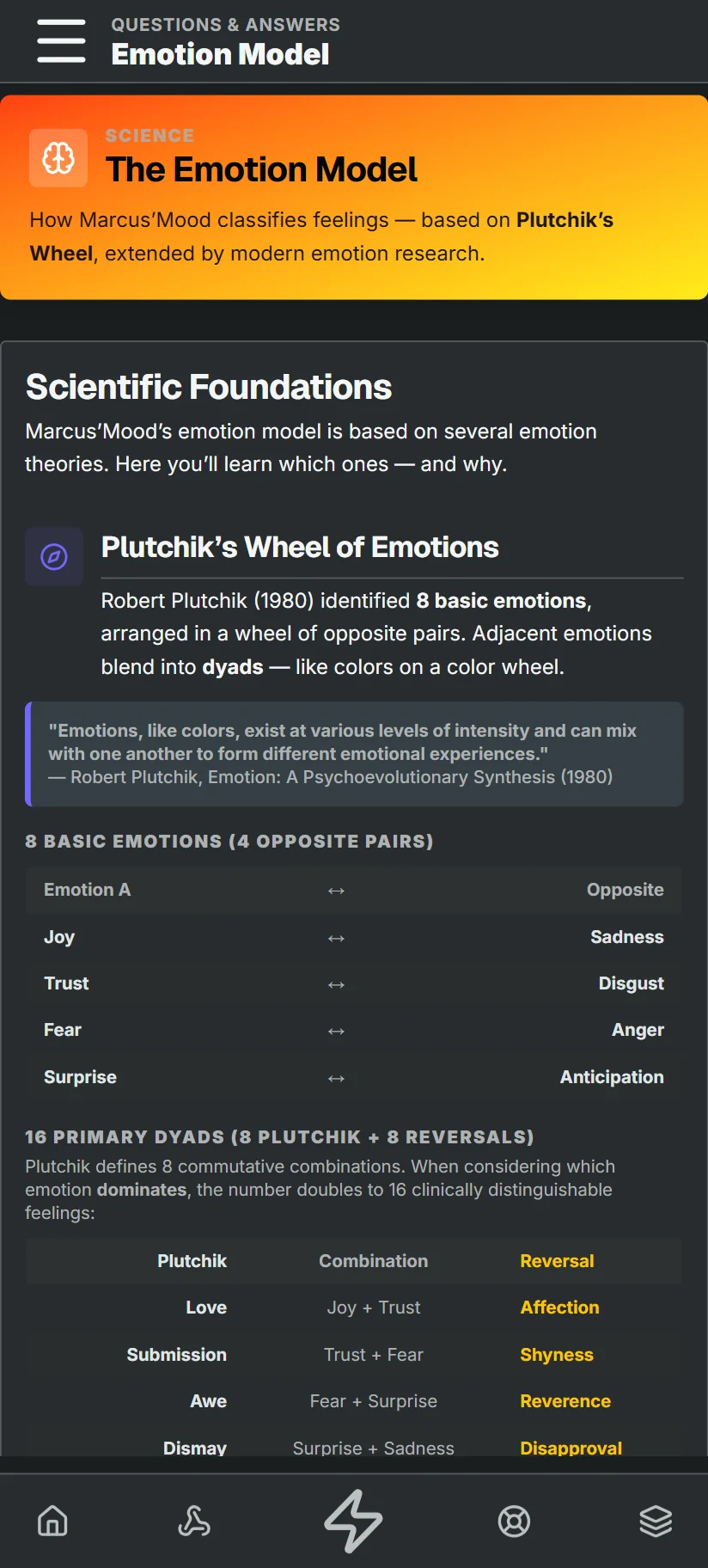
Why does anger sometimes feel like fear? Why does relief sometimes follow long sadness? Marcus'Mood explains what's behind it – based on the Plutchik wheel, one of the strongest models in emotion psychology.
- 8 primary emotions + 2 DBT states – and how they connect
- Mixed emotions (dyads): why joy + fear = excitement
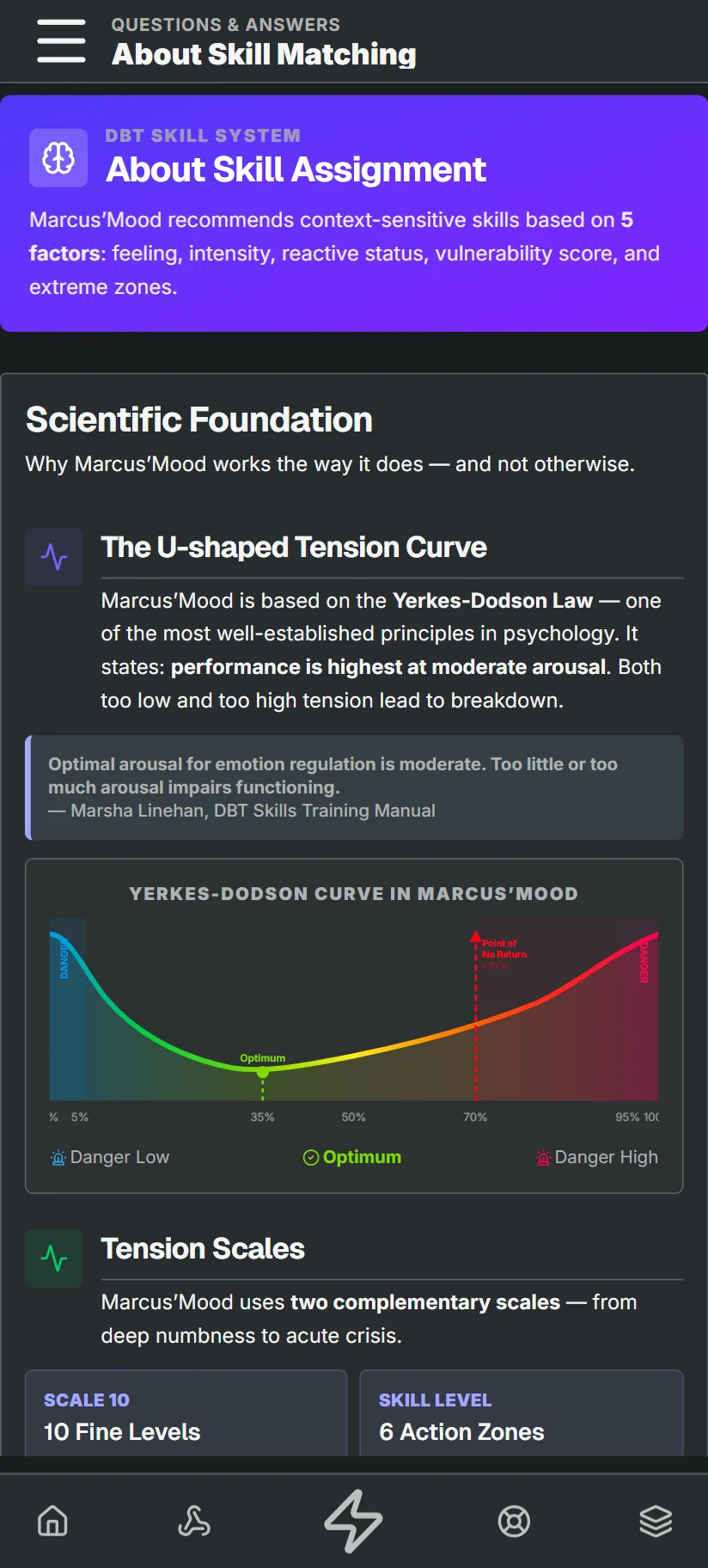
- Yerkes-Dodson: why moderate tension makes you more productive
- References – evidenced models, not claims
How skill matching works
Other apps show you a list. Marcus'Mood selects – based on what you're feeling right now, how strong it is, what you can do and where you are. That's the difference between eighty suggestions and one that fits.
- Emotion · intensity · availability · context – four dimensions simultaneously
- Crisis, activation, vulnerability – the right context per situation
- PLEASE factors feed in: sleep, nutrition, substances
- Rizvi et al. (APA): 68% distress reduction per app session
Emotion playbook
History & analytics
Patterns you would never have seen on your own.
Sometimes you only see after weeks what regularly happens. The analytics makes visible what you can't track on your own.
Trend curve
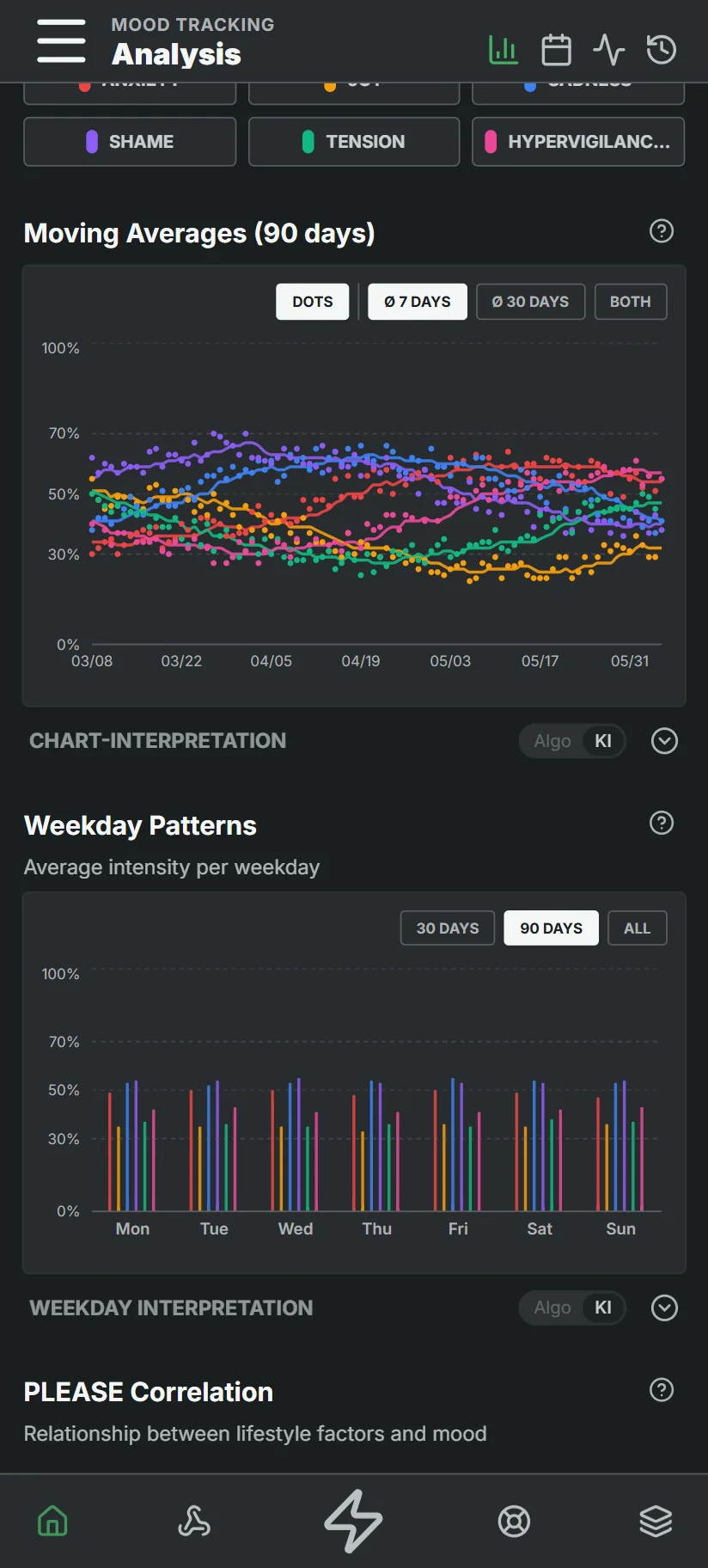
You choose an emotion – the app shows you how it has developed over weeks. Whether it's actually getting worse, or just feels that way.
- Intensity history of individual emotions over weeks
- 14-day smoothing: trends instead of daily fluctuations
- Multiple emotions comparable simultaneously
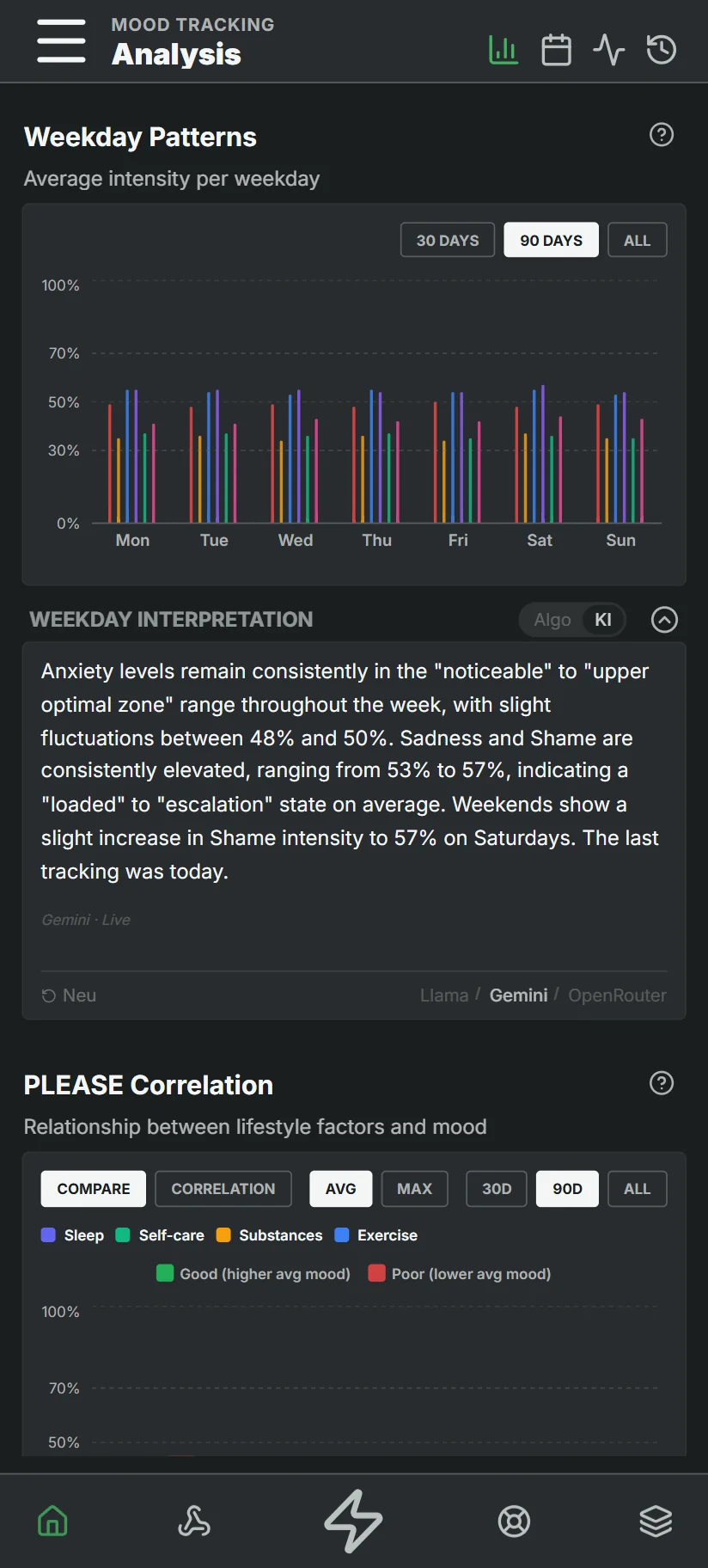
- Weekday patterns: when you're regularly higher
Calendar
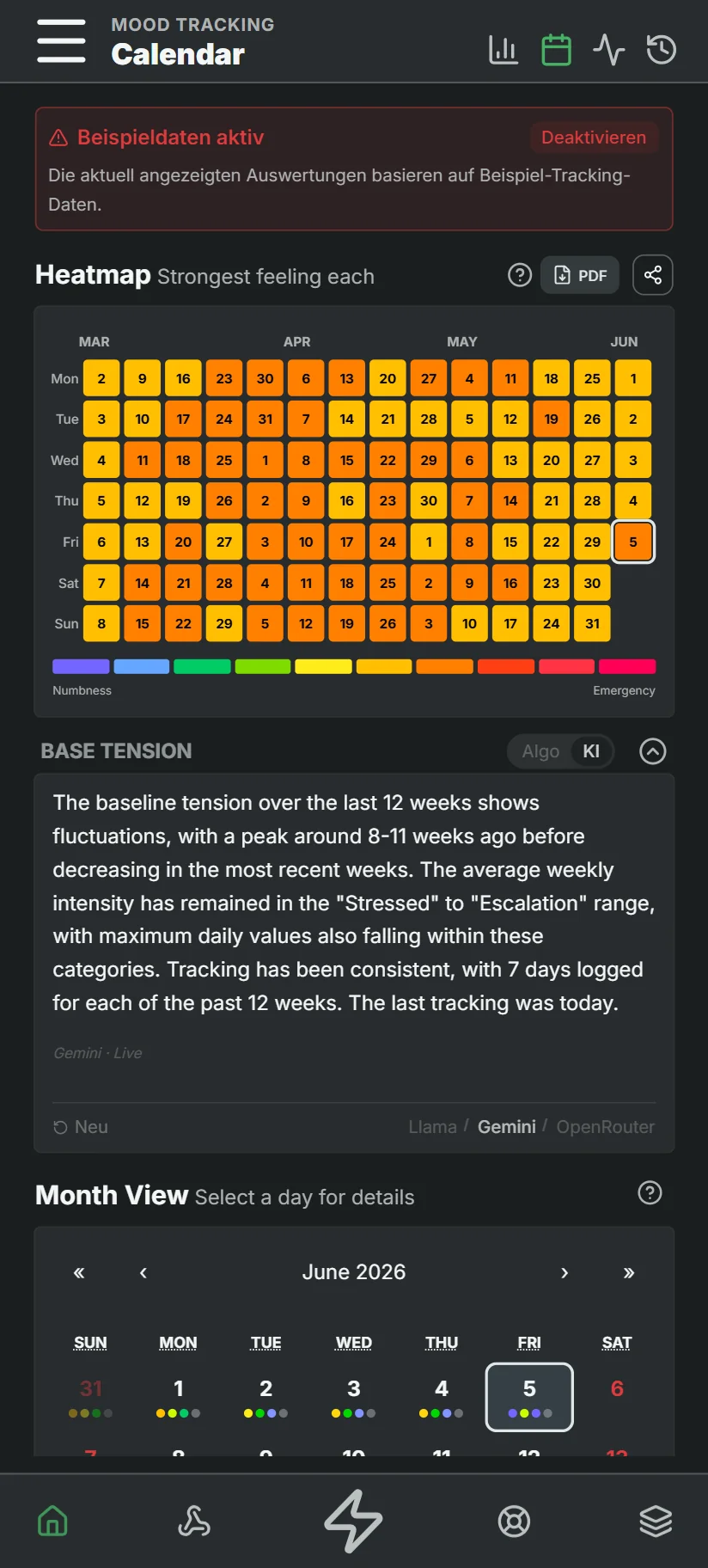
Which days of the week are regularly hard? Are there months when you're more stable? The calendar makes time rhythms visible that you don't notice in daily life.
- Heatmap: 13 weeks – intensity at a glance
- Monthly view with intensity dots per day
- Day detail: all entries for a day
- AI assessment of baseline tension
History
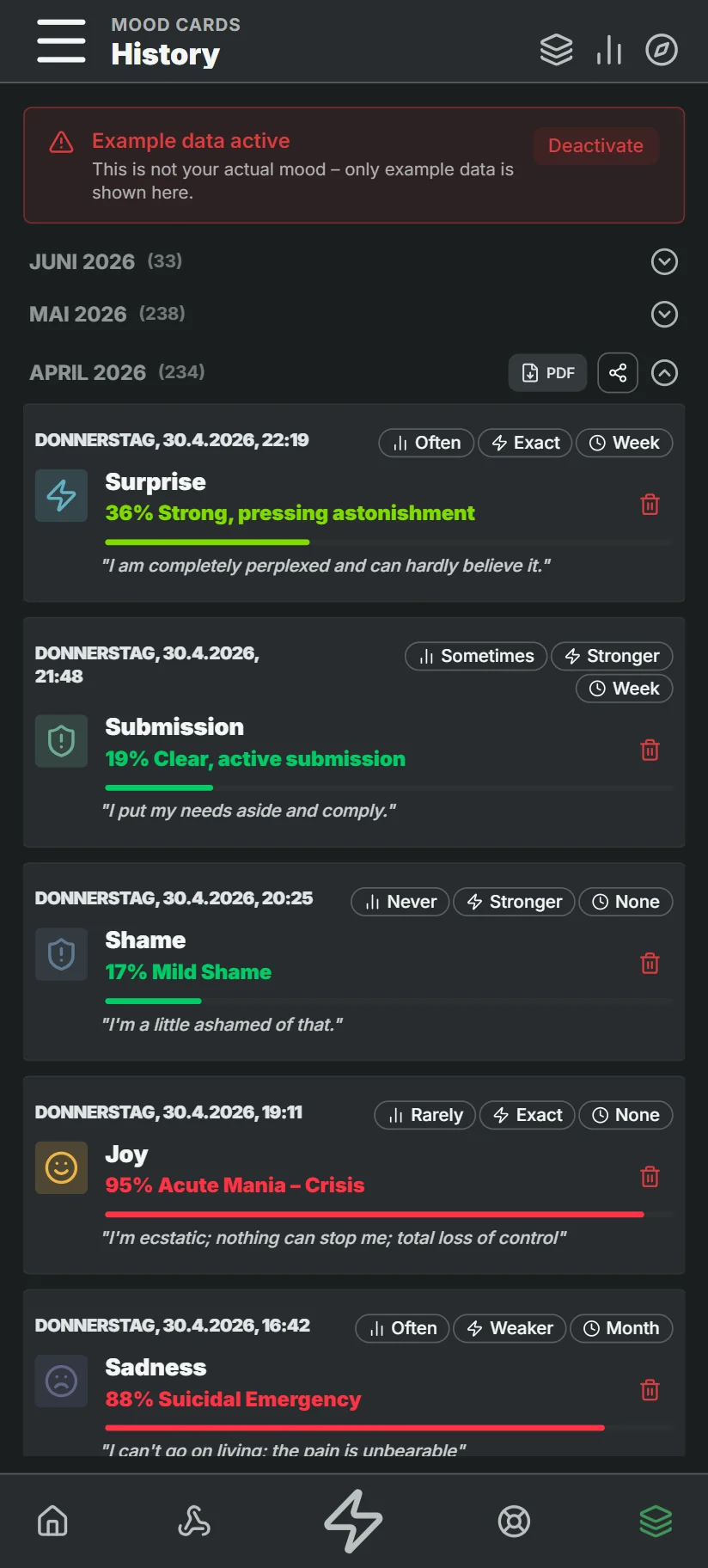
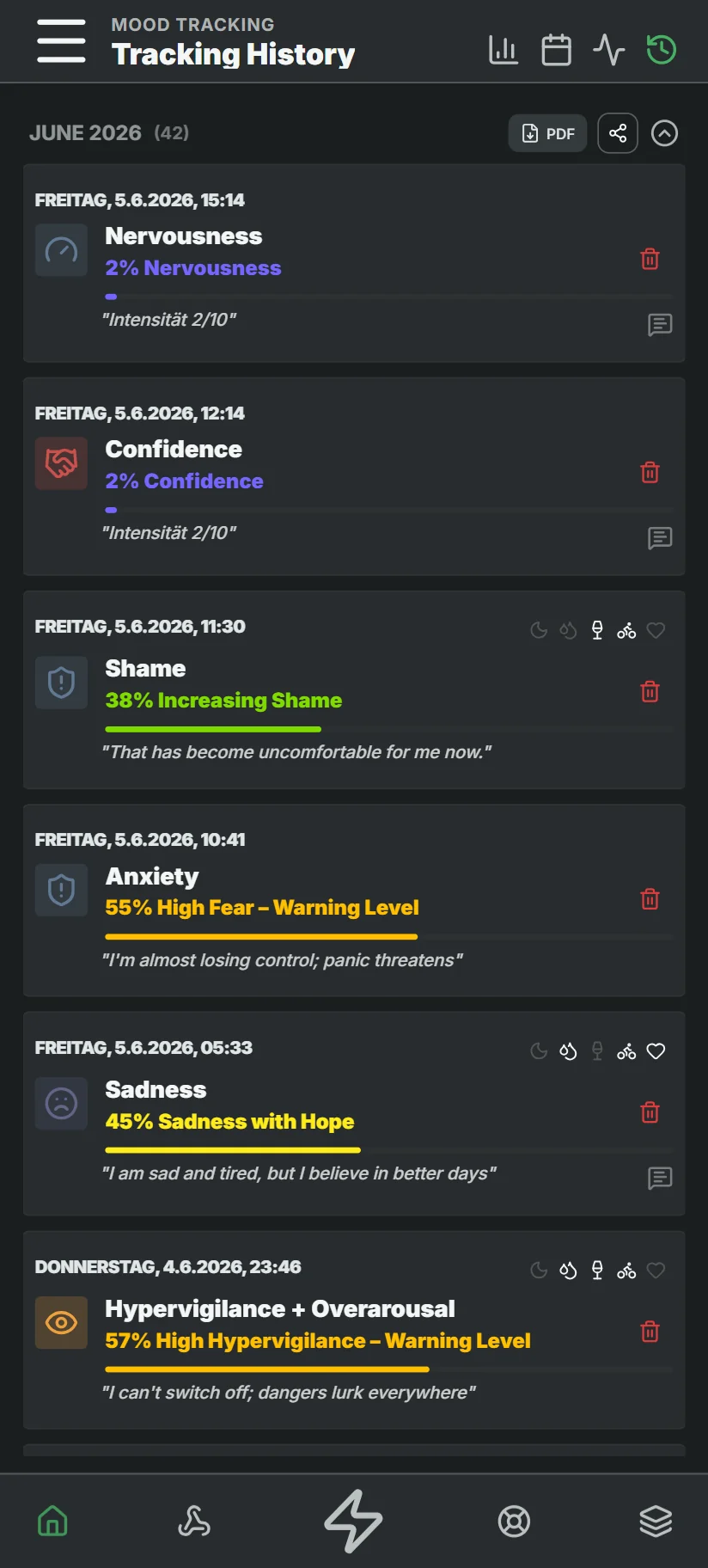
Every entry you made – chronologically, with notes, AI interpretation and PLEASE factors. Your personal emotion journal.
- Complete entry history with notes
- AI interpretation per entry as orientation
- PLEASE factors: sleep, movement, substances
- Monthly PDF export
PDF report
For your next therapy session – or just for yourself. Mood curve, PLEASE correlation, most frequent emotions. Generated locally, no server.
- 8 sections: curve, weekday, PLEASE, daily history and more
- Generated locally – your data never leaves the device
- Share or save directly from the app
- You arrive at sessions with data – not vague memories
Mood curve
Your patients describe "the last few weeks were bad". The curve shows you whether intensity actually increased – or whether it just feels that way.
- 14-day smoothing: trends instead of daily fluctuations
- Multiple emotions simultaneously – emotional clusters recognisable
- Difference between perception and data visible
- Shared conversation basis instead of memory reconstruction
Calendar
Which days of the week regularly show high intensities? Are there seasonal patterns? The calendar provides an overview immediately readable in session.
- Heatmap: 13 weeks at a glance
- Day detail: all entries for targeted follow-up questions
- Rhythms: regular stress patterns recognisable
- Immediately understandable – no training needed
History
Every tracking entry chronologically – with notes, AI interpretation and PLEASE factors. Your patients keep a structured log without experiencing it as a chore.
- Complete entry history with notes
- PLEASE factors: sleep, movement, substances, stress
- AI assessment per entry as orientation
- Monthly PDF export as therapy protocol
PDF history report
Clinically structured, locally generated, privacy-compliant. Your patients bring it along. You get straight to work.
- 8 sections: curve, weekday patterns, PLEASE correlation, top emotions and more
- Generated locally – no server, no privacy issues
- Patients share directly from the app
- NIH study: 61% of therapists held a phone up to a webcam – because structured data was missing
All history data stays locally on your device – no server, no cloud.*
* Exception: optional AI analysis with your own API key – only active when you consciously enable it.
Trend curve
AI analysis: optional with your own API key
Your patterns – interpreted. On request. With your key.
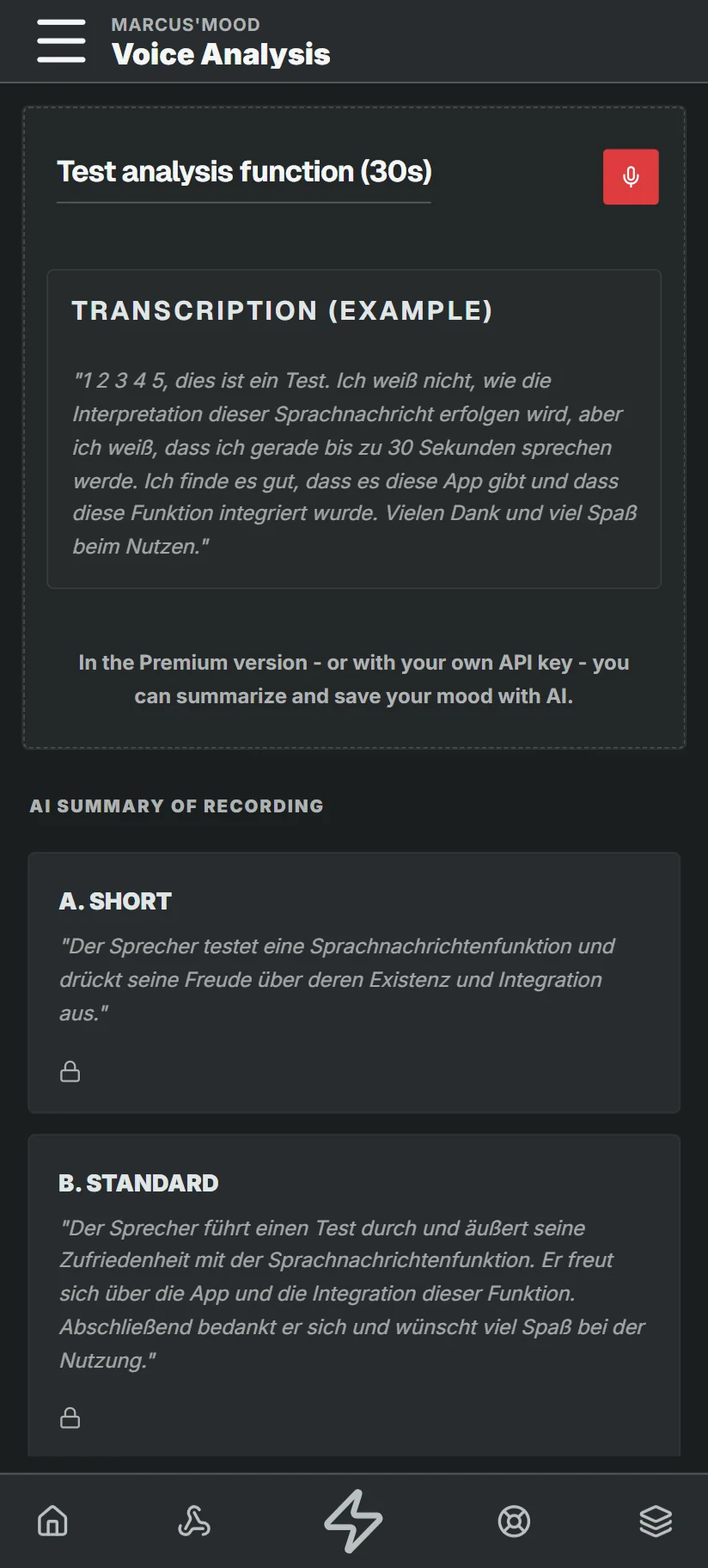
Marcus'Mood collects over weeks what no human can evaluate manually: mood histories, PLEASE correlations, MoodCards patterns. The optional AI analysis interprets this data – and shows you what you can't see yourself.
Audio notes
Speak freely – AI transcribes and interprets in the tracking moment
Chart interpretation
Trend, weekday, PLEASE – AI interprets what the data shows
Baseline mood profile
From 200 MoodCards: your emotional baseline interpreted
Free to use: Gemini and Groq both have a free API tier. One-time 5-minute setup – download quick guide.
Coming soon: A token model for everyone without their own key is in preparation.
All other apps send your data to their AI servers – without you noticing. Marcus'Mood doesn't. The AI analysis is disabled by default. When you activate it, your data goes directly to your chosen provider – not to us.
AI analysis · Pro
Integrated tools
Integrated tools from breathing exercises to Sudoku – directly applicable.
No app-within-an-app. The tools are integrated in Marcus'Mood and follow directly from the skill suggestion – no switching needed.
Breathing exercises
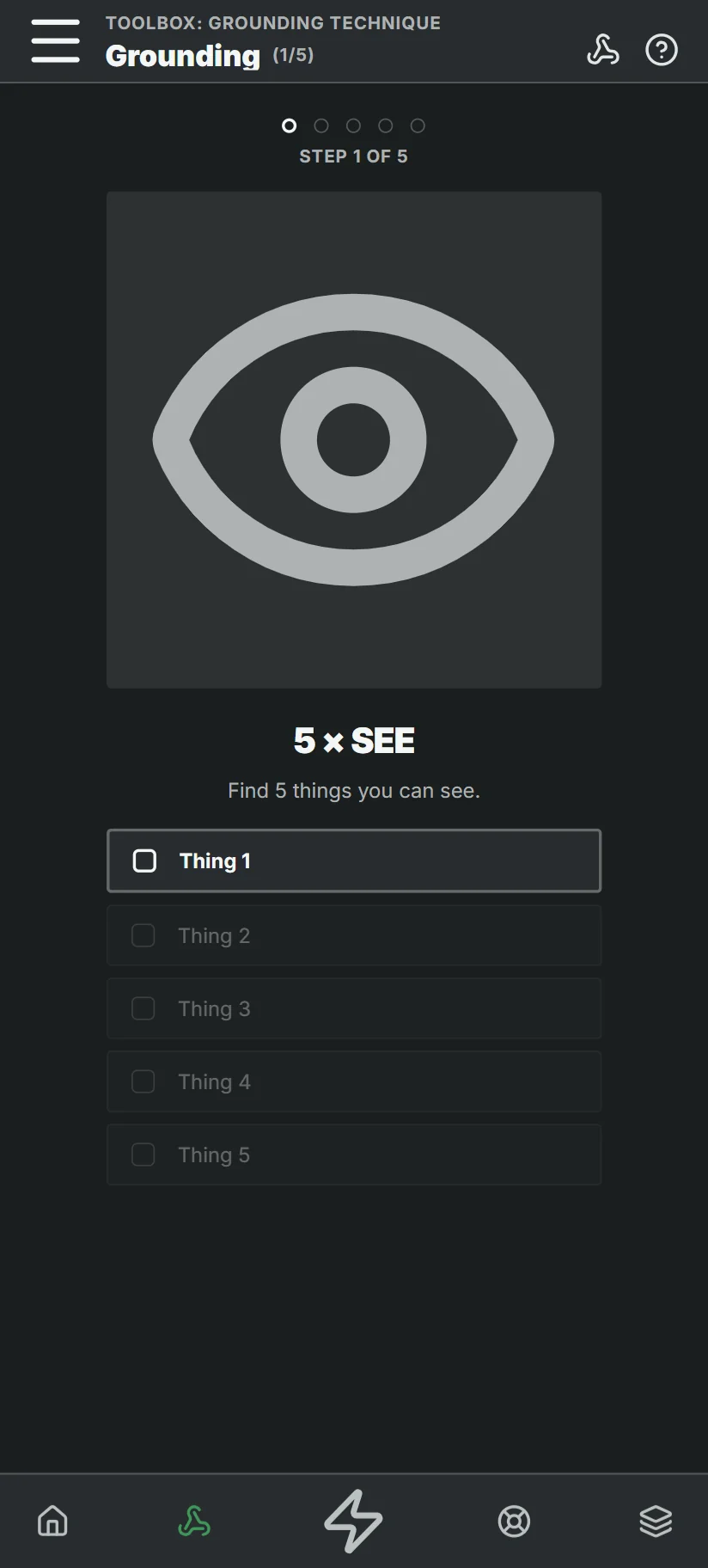
Grounding & body scan
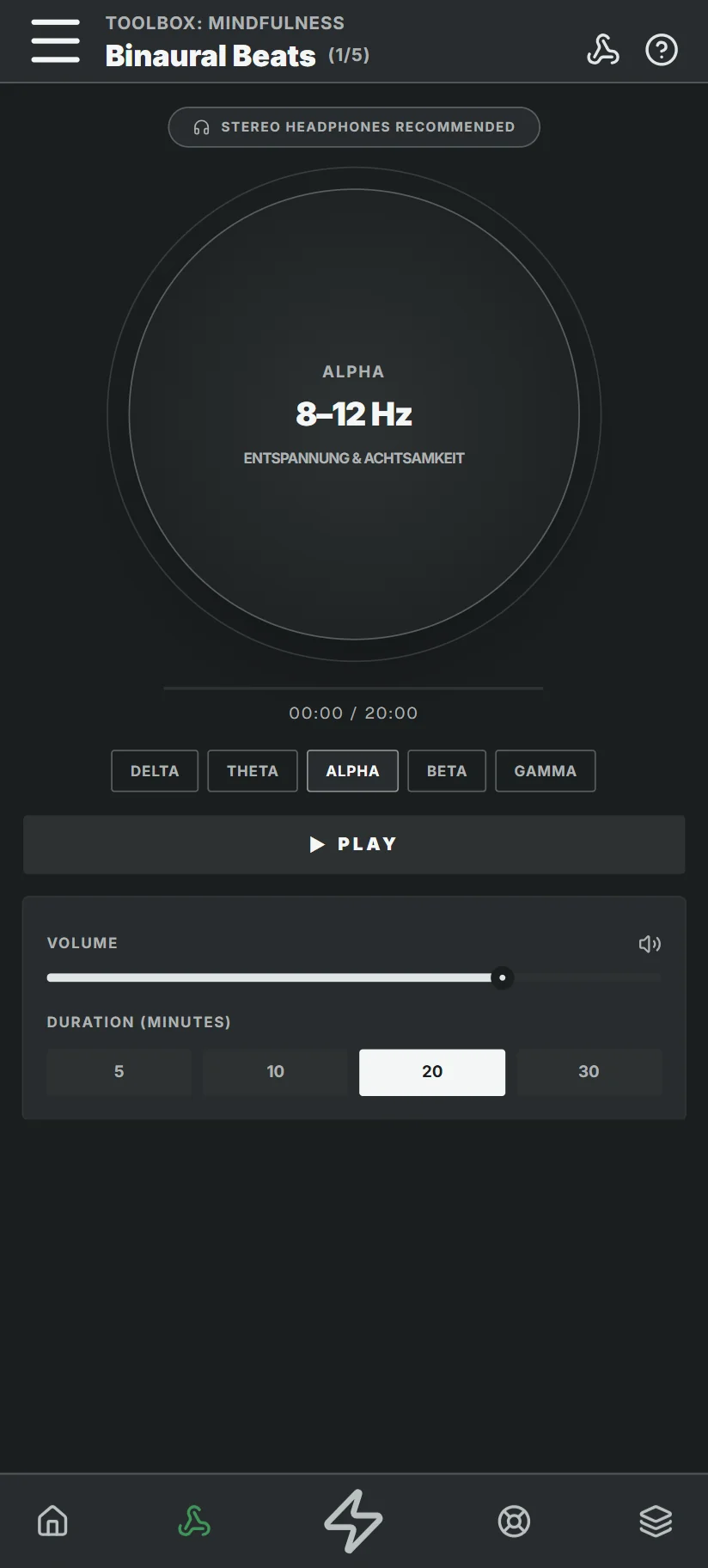
Binaural beats
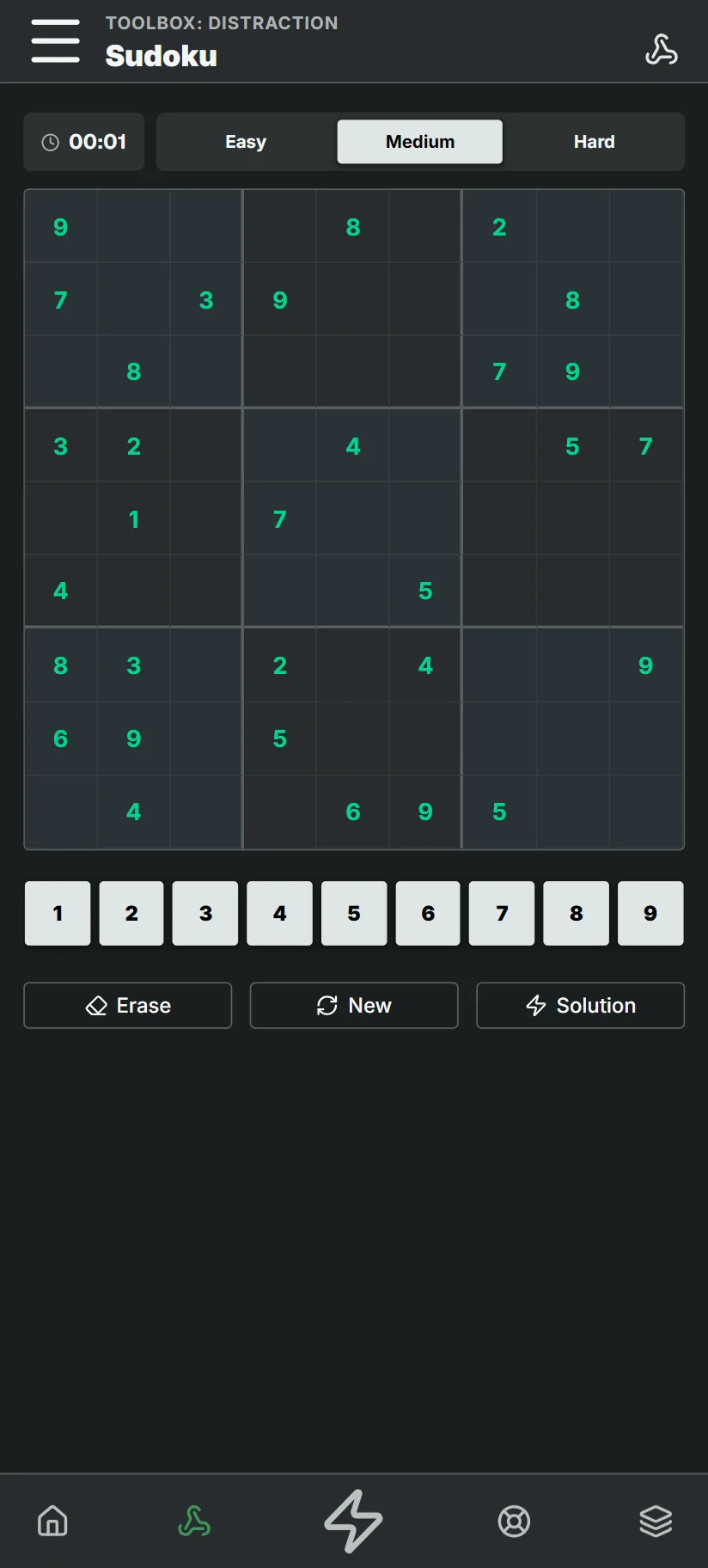
Sudoku
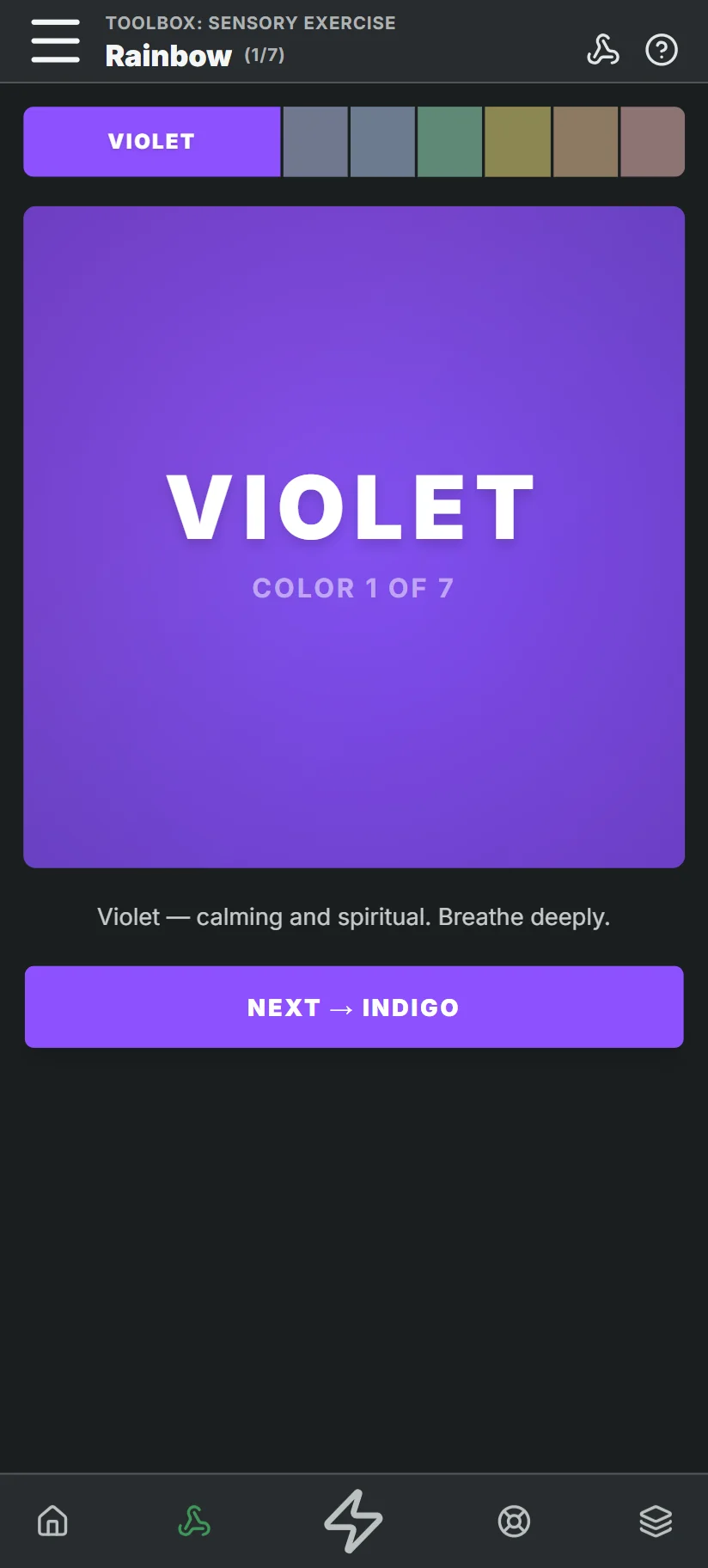
Rainbow view
Tools & setup
The app adapts to you – not the other way around.
From the PLEASE check to data export: you stay in control.
PLEASE check
Explains why you are more sensitive today – sleep, movement, nutrition feed directly into skill matching
Daily goal & streak
Set a daily goal, track your streak – the difference between a short attempt and a real habit
8 integrated tools
Breathing, binaural beats, grounding, body scan, Sudoku – usable directly from a skill
Customisable
No feature overload – you only see what you actually use. Multiple languages available.
Your data belongs to you
Full JSON export, at any time – your story stays your story
Scientific foundation
Not invented – evidenced.
Five findings from independent clinical research on DBT apps – different studies, different populations, the same conclusion: most apps don't solve the problem. Marcus'Mood is deliberately built differently in each of these areas.
What research shows – and what it means for you
When you open a skill in a difficult moment, the odds are in your favour. That's not coincidence – that's DBT, applied.
68% of sessions with skill use led to a measurable decrease in distress.
Fast Track is not a convenience feature. It is the clinically grounded, necessary answer to the biggest problem with DBT apps.
48% dropout rate in a controlled study with 576 participants.
Sticking with it pays off – and that's exactly what Marcus'Mood makes easier. Daily. In under 30 seconds.
31% fewer episodes after 6 weeks in the same RCT study.
For professionals recommending Marcus'Mood
Marcus'Mood offers complete diary card tracking, 111 differentiated emotions and 4D skill matching – one of the few exceptions on the market.
Only 23% of 21 analysed DBT apps had a complete diary card at all.
Marcus'Mood exports histories, calendars and skills as a structured PDF – session-ready, at the push of a button. No workaround.
61% of therapists had to ask patients to hold their phone up to a webcam.
When you actively support clients using Marcus'Mood, they are significantly more likely to stick with it – that's not coincidence, it's evidenced.
Therapist-assisted apps have 30–40% lower dropout rates than self-directed ones.
The studies cited were not conducted on Marcus'Mood and refer to other DBT apps under study conditions. They evidence general effectiveness principles of DBT app use, on the basis of which Marcus'Mood was developed.
The models behind it
Plutchik (1980)
111 emotions based on one of the most cited emotion models
Plutchik (1980)
111 emotions based on one of the most cited emotion models
DBT by Linehan
Skills from Dialectical Behaviour Therapy
DBT by Linehan
Skills from Dialectical Behaviour Therapy
PLEASE framework (DBT)
Biological factors that influence emotional resilience
PLEASE framework (DBT)
Biological factors that influence emotional resilience
What makes Marcus'Mood different
Built for the moment that matters.
Not optimised for good days — but for all the others.
111 emotions – each with depth
Emotion chain, profile, related feelings, dyads. No emoji tracking.
4D skill matching
Emotion + intensity + reactivity + vulnerability – that determines what gets suggested.
Personal skill kit
Packed when calm – so you don't have to search in a crisis.
History & PDF export
Make patterns visible over time. Export session-ready reports in one tap.
Fast Track – under 30 seconds
A complete check-in even when things aren't going well. No blank field waiting for text.
MoodCards
Pattern recognition without a questionnaire – automatically from daily tracking.
100% local & private
No cloud, no account, no subscription.
What users say
Real moments. Real voices.
"I now bring real data to sessions. My therapist can see at a glance what the past week looked like – no guessing, finally a real foundation."
"It helped me for the first time when I didn't even know why I was struggling. No login, no explanation needed – just there."
"The combination of structured mood tracking and directly mapped DBT skills is very valuable for therapy support. Clients come with concrete data instead of vague memories."
"What convinces me: the app uses the Plutchik model and a clear DBT taxonomy – that's scientifically grounded, not just marketing. Local data storage removes an important barrier."
Privacy
No account. No cloud.
No compromise.
NIH study: 61% of therapists had to ask patients to hold their phone up to a webcam – because no local file transfer was possible.
Your data never leaves your device.
Moods, crises, patterns – these are among the most sensitive data you will ever record. They never leave your device. No account, no tracking, no cloud. The optional AI analysis is the only exception – and only active when you consciously enable it.
Everything stays local
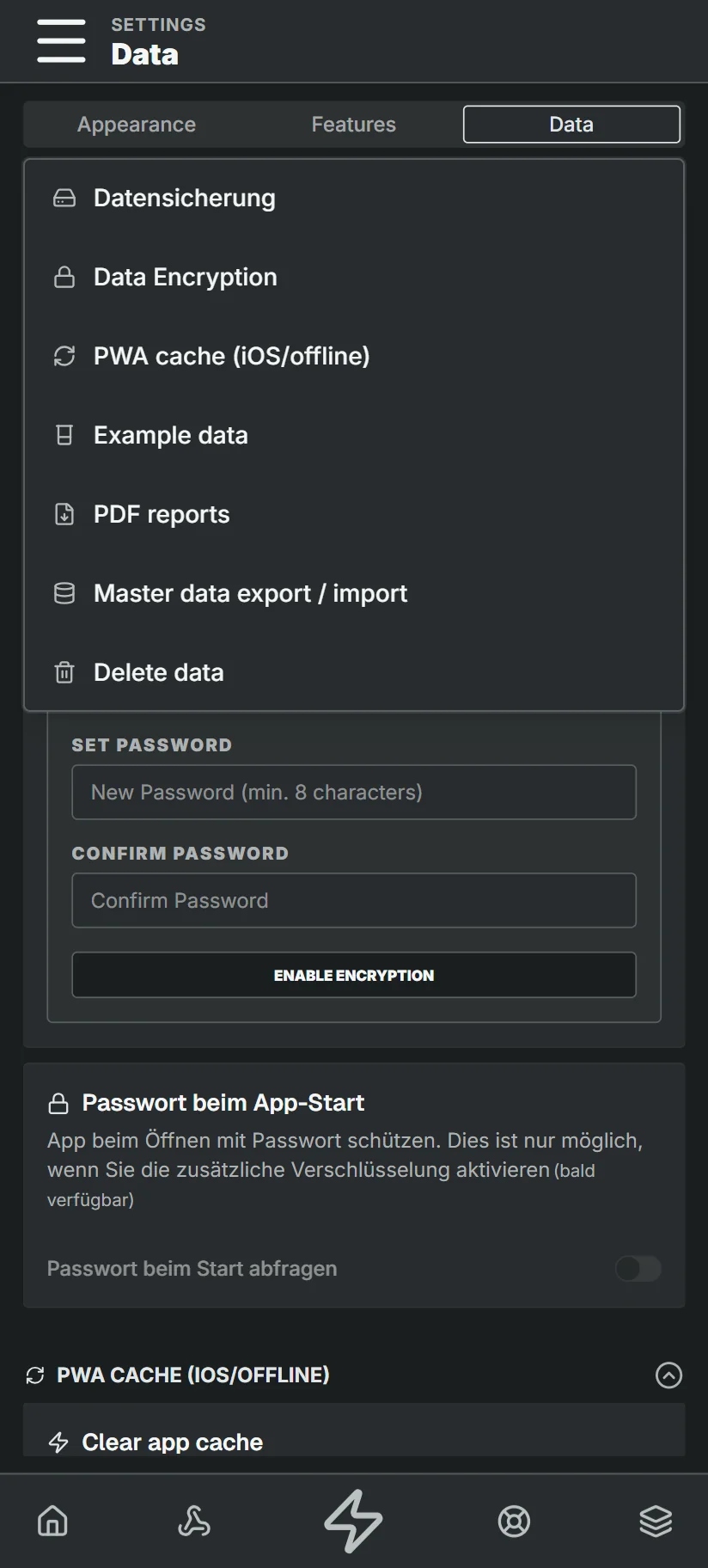
Your tracking data, skills and MoodCards never leave your device. No server receives them, no cloud service stores them. The only place your data exists is your smartphone – encrypted with AES-256-GCM.
Not collecting data means not having to protect it
We collect no personal data – which means we have nothing to protect, nothing to delete, and nothing that could leak in a breach. This is the most consistent form of privacy: not collecting rather than protecting.
No account required
No email address, no password, no registration – you start immediately. No forced sign-up after the first launch. No "Forced Email" like other mental health apps.
Full control
Export, deletion, backup – all in your hands. You can export all data as JSON, encrypt it, and restore it on another device. Nothing happens without your explicit action.
AI analysis – only when you want it
The optional AI analysis does send data externally – but only when you choose to. Requirement: your own API key, entered in settings. Data goes directly to your chosen provider – not to us. Without a key, everything runs fully offline.
Explore the app
Take a look – click through.
Choose a category and click on a screenshot – each image explains itself.
Start screen
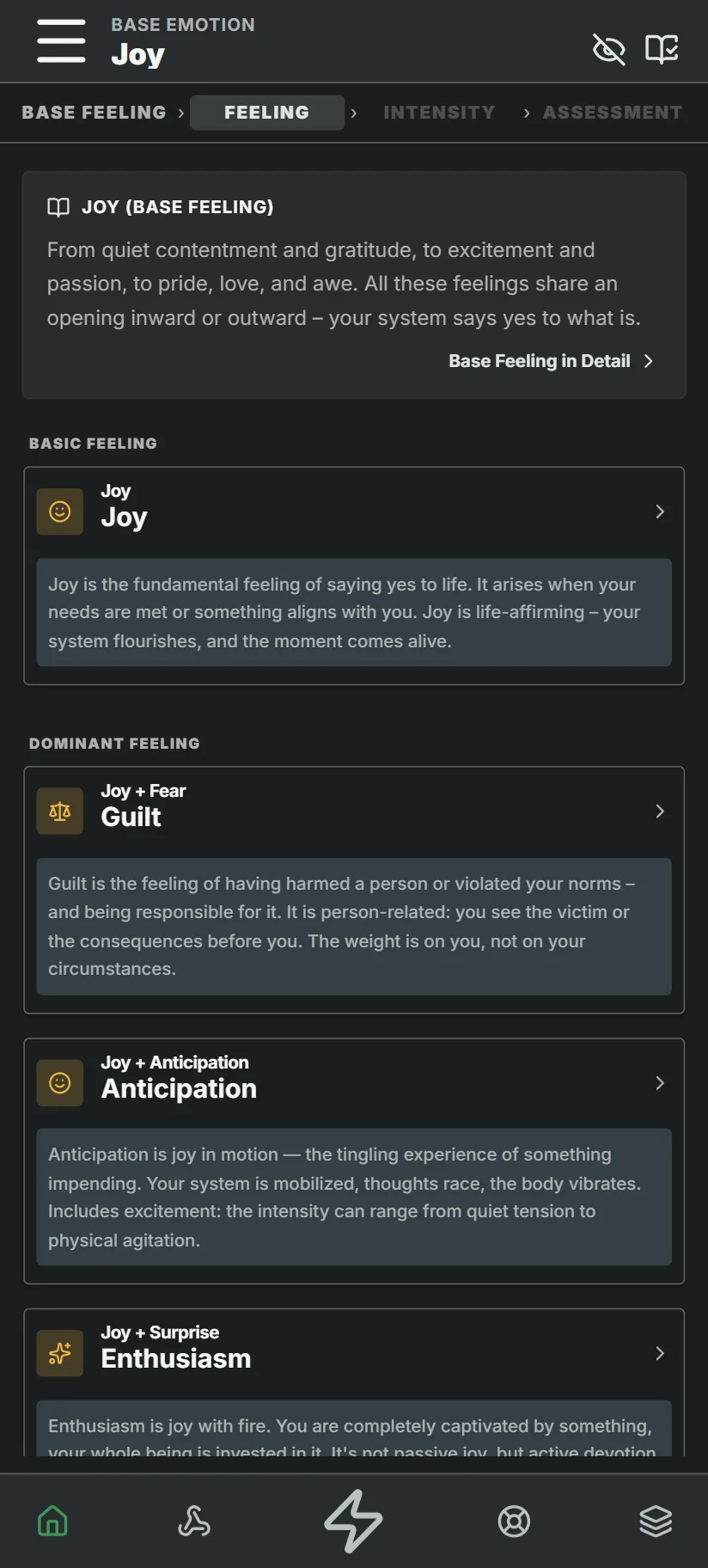
Emotion selection
Intensity scale
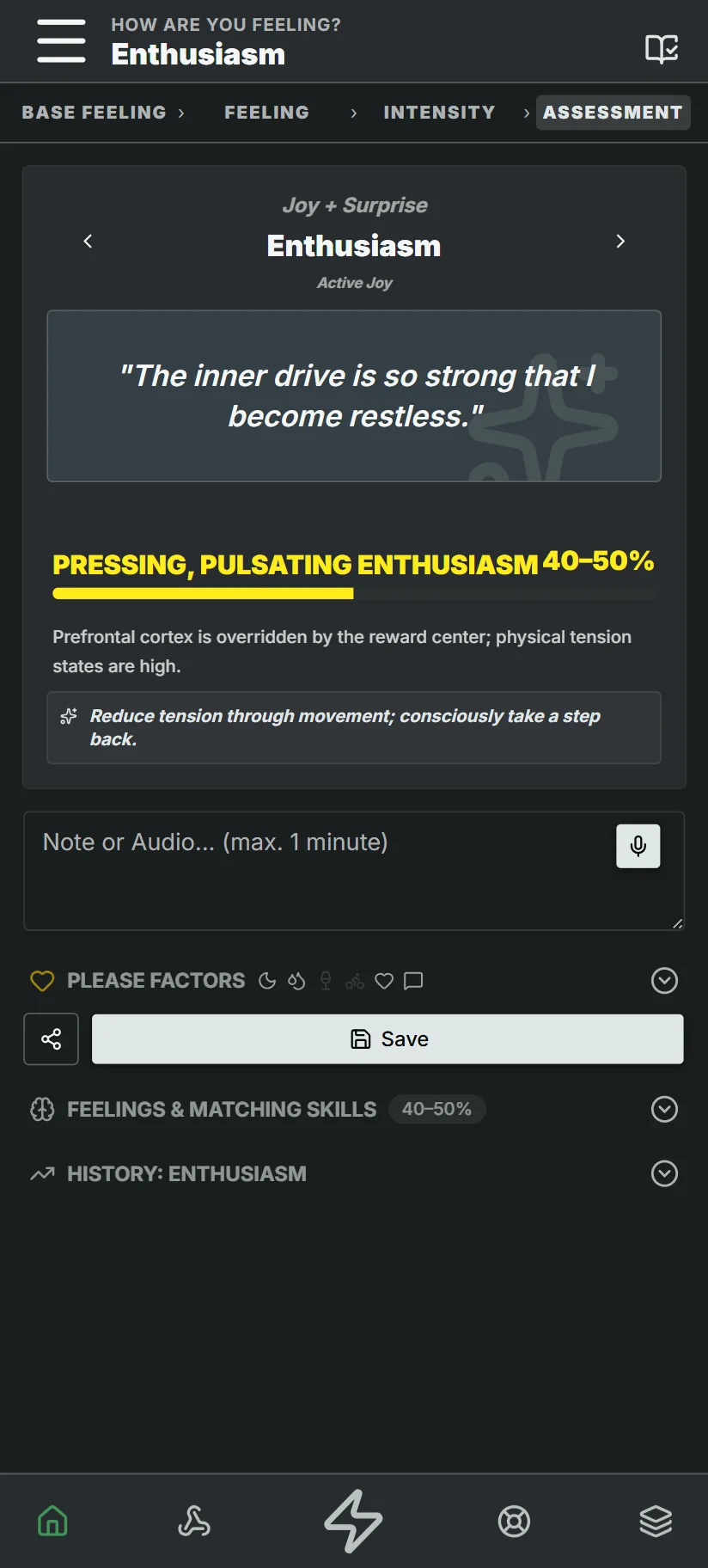
Summary view
Fast Track
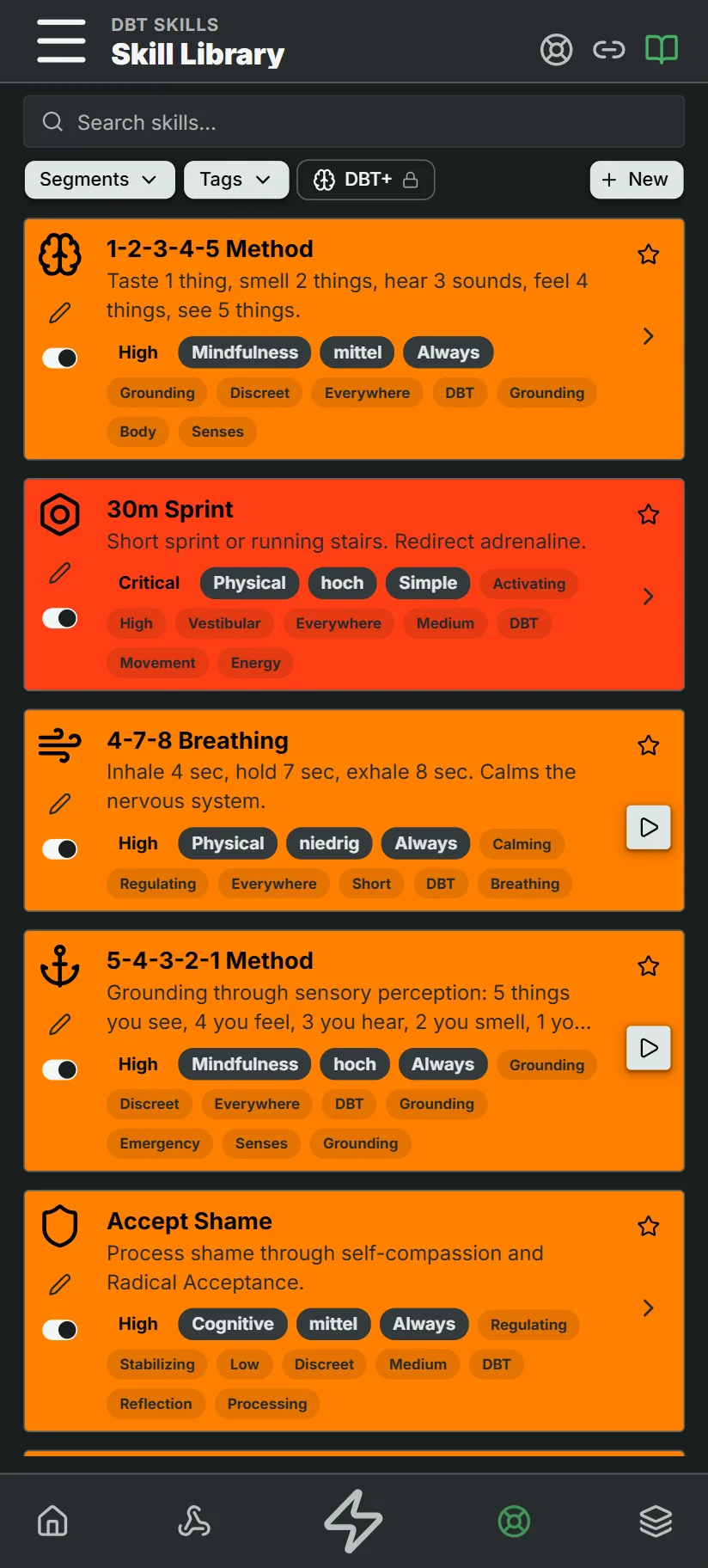
Skill library
Skill detail
Skill matrix
Skill kit
Skill chains
Dashboard
MoodCards assessment
History
Interpretation
Feedback
Review
Calendar + AI
Trends + AI
Weekday patterns
History
Breathing exercise
Binaural beats
Grounding / body scan
Sudoku
Rainbow view
Emotion profile
Plutchik model
Emotion chain
Skill matching
About the app
Free or Pro?
Free forever.
The free version is not a demo. It's fully featured – and stays that way. The Pro version adds more for those who want to go deeper.
Fully featured
No expiry date, no hidden limits.
- Mood tracking with 111 differentiated emotions
- Fast Track – checked in within 5 taps
- 167 DBT skills with personal skill kit
- Calendar heatmap, history & trends
- MoodCards assessment & dashboard
- Tools: breathing, grounding, body scan
- No account. No subscription. No ads.
For those who want to go deeper
One-time purchase. No subscription. No expiry.
- Everything in the free version
- 695 extended DBT+ skills
- AI voice analysis of your entries
- Advanced analytics & PDF export for therapy sessions
- Binaural beats, focus music, ambient sounds
- Grows with real user feedback
Pro version is in development. Using the app now supports its continued growth.
Video Introduction
Faster than any manual.
Questions & answers
Frequently asked questions
What is "4D skill matching" – and how does it work?
Most apps suggest skills along a single axis: "Bad mood → here's a breathing exercise." That doesn't go far enough. Marcus'Mood combines four pieces of information:
1. Emotion – What exactly is the feeling? (111 entries following Plutchik + DBT, not 5 emojis)
2. Intensity – How strong is it right now? (0–100%, in 10 levels)
3. Reactivity – Is this a first reaction to a situation – or a feeling about a feeling? (e.g. shame about feeling afraid). For reactive emotions, self-compassion and Radical Acceptance are needed first, not a breathing exercise.
4. Vulnerability (PLEASE) – How biologically vulnerable are you right now? Sleep, nutrition, substances, movement and baseline mood influence which skills are realistically applicable.
From the combination of these four factors, a matched skill list is calculated for each emotion – no generic recommendations, but context-sensitive matching following DBT logic.
What does Marcus'Mood cost?
The app is free – permanently, no expiry date, no hidden limits. A Pro version with extended features (PDF export, AI analysis, DBT+ skills, binaural beats and more) is in development and will be available as a one-time purchase. No subscription, no automatic renewal. The price will be announced on release.
What is Fast Track – and how does the ⚡ symbol work?
The ⚡ symbol in the app footer opens Fast Track. With it you check in several favourite emotions one after another – you only choose the intensity, everything else runs automatically. On first launch, five common emotions are already saved as favourites, which you can adjust at any time. Result: a complete tracking entry in under 30 seconds.
What is the difference between the free version and Pro?
The free version is fully featured – mood tracking, 167 DBT skills, Fast Track, calendar, MoodCards, history, tools. No artificial ceiling. The Pro version (in development) extends the offering with 695 additional DBT+ skills, AI voice analysis, PDF export for therapy sessions, binaural beats and more. Pro will be available as a one-time purchase.
What happens to my data?
All tracking data stays locally on your device. We collect none, store none, see none. The only exception is the optional AI analysis (Pro): it sends data only when you activate it with your own API key – and even then only to the service you choose, not to us.
Does the app work without internet?
Completely. Tracking, skills, MoodCards, review, tools – everything runs offline. An internet connection is only needed if you optionally use the AI analysis with your own API key. Everything else works without a connection.
Do I need to know DBT to use the app?
No. The app explains all concepts – Plutchik, DBT modules, PLEASE – step by step. No prior knowledge needed. If you already have DBT knowledge, the app offers significantly more depth: specific skill assignments, structured tracking for therapy sessions and the complete DBT+ skill catalogue.
Does Marcus'Mood replace therapy?
No – and that's a good thing. The app accompanies therapy, it doesn't replace it. It helps with applying skills between sessions, making patterns visible, and going into the next appointment with structure. In acute crises: please contact a crisis helpline in your country.
What is the difference from Daylio or other mood trackers?
Daylio is a mood diary – it tracks moods but doesn't suggest skills. Marcus'Mood does both: name an emotion and then suggest concrete DBT skills that fit this emotion, this intensity and this moment. Also: 111 emotions instead of 5–20 emojis, 100% local, no subscription.
The story behind it
Why this app exists
I know that moment: you're stuck in something difficult and just want to know what could help right now. But nothing is at hand that simply works. Offline, without three steps first.
Maybe you know the feeling too. That's where this app came from – not as a product, but as an answer to a very specific situation.
What it became is more than originally planned. But the core principle stayed: simple enough for difficult moments. Deep enough to actually help.
No corporation behind it. No subscription pressure. Just someone who had the same problem – and decided to solve it.
Get started
Your next step begins with a feeling.
Just start. Your emotions, your skills, your path – no account, no cloud, no subscription.
Marcus'Mood is not a diagnostic tool – it supports you in understanding yourself better. · Privacy Policy
Plutchik (1980)
The wheel of emotions – 8 building blocks, 111 differentiations
Robert Plutchik described eight evolutionary primary emotions as survival strategies. Each fulfils a biological function – together they form the foundation of all human feelings.
| Emotion | Evolutionary function |
|---|---|
| Fear | Protection from threat |
| Anger | Self-defence |
| Joy | Bonding and reproduction |
| Sadness | Processing loss, reintegration |
| Trust | Social belonging |
| Disgust | Avoiding harm |
| Surprise | Orientation to the new |
| Anticipation | Forward-looking action |
| Combination | Result |
|---|---|
| Joy + Trust | Love |
| Trust + Fear | Submission |
| Fear + Surprise | Awe / shock |
| Anger + Disgust | Contempt |
| Sadness + Surprise | Disappointment |
Source: Plutchik, R. (1980). Emotion: A Psychoevolutionary Synthesis. Harper & Row. · DBT states added: Linehan (1993)
DBT by Linehan
Why 4 factors – not just intensity
A skill that helps with low-level anxiety can be counterproductive with reactive shame. Marcus'Mood considers four dimensions simultaneously.
| Factor | What it determines |
|---|---|
| Emotion | Which of the 111 emotions and states |
| Intensity | 0–100%, divided into 10 DBT levels |
| Reactive status | Primary feeling or reaction to another |
| PLEASE score | Current vulnerability (0–5 factors) |
| Intensity | Primary modules |
|---|---|
| 10–30 % | Mindfulness, Emotion Regulation |
| 40–60 % | Emotion Regulation, Interpersonal Effectiveness |
| 70–80 % | Distress Tolerance, Emotion Regulation |
| 90–100 % | Distress Tolerance – TIPP as primary skill |
Source: Linehan, M. M. (1993/2015). Cognitive-Behavioral Treatment of BPD & DBT Skills Training Manual. Guilford Press.
PLEASE framework (DBT)
Why the body overrides the mind
In a crisis, the nervous system reacts faster than the mind. DBT has a name for this: PLEASE – the biological ground beneath all skills.
| Letter | Meaning | Why it matters |
|---|---|---|
| PL | PhysicaL illness | Physical illness increases emotional irritability |
| E | Eating | Blood sugar fluctuations destabilise mood |
| A | Avoid substances | Mood-altering substances inhibit regulation |
| S | Sleep | Sleep deprivation amplifies every emotional reaction |
| E | Exercise | Movement regulates cortisol and baseline stress |
- At ≥ 3 factors: "Stabilisation" badge + prioritisation of stabilising skills
- In the review: PLEASE correlation chart shows the link with emotion intensity over weeks
- PDF export includes PLEASE history for the therapy session
Source: Linehan, M. M. (1993). DBT Skills Training Manual. Guilford Press. · Vulnerability research: Segal, Williams & Teasdale (2002)